


When importing autonomous forklifts from China, buyers often focus on the vehicle itself and overlook one critical part of the system:
the automated charging infrastructure.
A charging station may connect directly to the warehouse electrical system and operate at significant voltage and current levels.
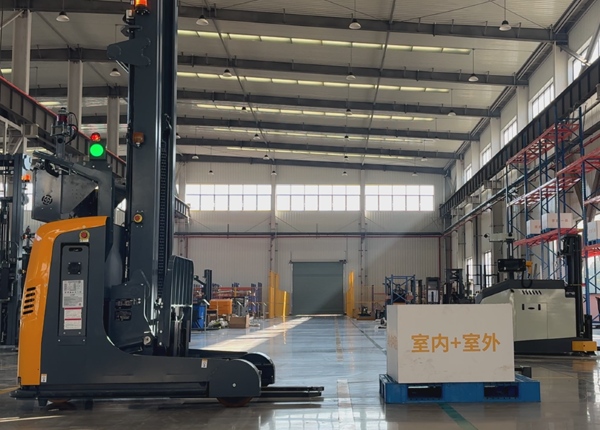
For a U.S. warehouse, the important question is therefore not simply whether the charger is manufactured in China.
The real question is:
Does the complete charging system, including the equipment and its installation, satisfy the electrical safety requirements applicable at the local facility?
Before shipment, the buyer should confirm the charger's electrical ratings, protection architecture, applicable certifications and installation requirements.
A Chinese manufacturer may supply charging equipment designed for international markets, but certification should be verified for the specific charger model and configuration being purchased.
Do not assume that a CE mark automatically means the equipment is approved for use in the United States.
For a U.S. deployment, the project team may need to evaluate:
Applicable electrical codes
Charger voltage and current
Installation method
Equipment listing
NRTL certification or field evaluation requirements
Disconnect requirements
Grounding
Overcurrent protection
Emergency-stop arrangements
Battery charging environment
The local electrical inspector or Authority Having Jurisdiction (AHJ) may determine what is required for the actual installation.
Before placing the order, ask the manufacturer for the complete certification package for the exact charging model.
Depending on the equipment, useful documentation may include:
Product certification
Test reports
Declaration of conformity
Electrical specifications
Wiring diagrams
Protection-circuit documentation
Installation instructions
Grounding requirements
Fuse and breaker specifications
Component certifications
Battery-charger manual
If the manufacturer claims that the charger is UL certified, ask for the specific certification information associated with the exact model, rather than relying only on a logo shown in a brochure.
The certification should correspond to the equipment actually being purchased.
Not necessarily.
CE marking is associated with European regulatory requirements.
It should not automatically be interpreted as approval for installation in a U.S. warehouse.
For American buyers, the more important question is:
What U.S.-recognized certification or evaluation applies to this specific charging equipment and installation?
The answer may depend on the charger design, electrical configuration and local requirements.
This is why the procurement team should review certification documentation with the facility's electrical engineer, qualified installer or AHJ before shipment.
The exact protection architecture depends on the charger's electrical design.
A properly engineered charging system may incorporate multiple layers of protection rather than relying on a single fuse.
Potential protection functions can include:
Input overcurrent protection
Short-circuit protection
Overvoltage protection
Overtemperature protection
Output-current monitoring
Ground-fault protection
Emergency shutdown
Battery communication
Charging interlocks
Thermal monitoring
The buyer should ask the Chinese manufacturer for the electrical protection diagram.
This is more useful than simply asking:
“Does the charger have a fuse?”
The charging system should have a defined response to abnormal battery conditions.
Depending on the AGV and battery architecture, the battery-management system may monitor parameters such as:
Cell voltage
Pack voltage
Charging current
Battery temperature
State of charge
State of health
If a monitored parameter exceeds its configured limit, the charging system may reduce or stop charging.
However, the exact protection sequence depends on the battery-management system, charger and vehicle controller.
The procurement specification should therefore define the expected behavior.
For example:
Abnormal temperature detected → Charging current reduced or charging stopped → Alarm generated → Vehicle unavailable until fault is cleared
The manufacturer should provide the actual control logic rather than leaving this as an assumption.
It can, provided the charger and battery-management architecture are designed to support the function.
A robust system should have communication between the battery-management system and charging controller.
Depending on the design, charging may be interrupted because of:
High cell temperature
Abnormal cell voltage
Excessive charging current
Communication failure
Battery fault
Charger fault
Emergency-stop activation
Ask the supplier to demonstrate these functions during factory testing.
During the Factory Acceptance Test, the customer can request evidence showing how the system responds to simulated fault conditions.
The test should verify:
Fault detection
Charging shutdown
Alarm generation
Vehicle status change
Recovery procedure
Fault logging
The test should be performed according to the manufacturer's approved safety procedure rather than by deliberately overheating a real battery.
These are related but not identical.
The charging equipment may monitor:
Input voltage
Output current
Internal temperature
Electrical faults
Communication status
The battery-management system may monitor:
Individual cell voltage
Cell temperature
Pack voltage
Charge current
Discharge current
State of charge
State of health
The safest architecture uses coordinated protection between the two.
If communication between the charger and battery is lost, the charging system should have a defined safe response.
This depends on the charger specification.
Before importing the equipment, determine:
Input voltage
Single-phase or three-phase
Frequency
Maximum input current
Rated charging power
Number of chargers
Simultaneous charging requirement
Circuit-breaker requirements
Cable size
Grounding requirements
Disconnect requirements
For example, a warehouse with ten AGVs may not require ten chargers operating at maximum power simultaneously.
The charging strategy could affect the peak electrical load.
Therefore, the electrical engineer should calculate the facility's expected maximum charging demand.
A basic preliminary calculation starts with:
Number of chargers × maximum charger input power
But this represents a worst-case connected load rather than necessarily the actual operating demand.
A more realistic design should consider:
Number of AGVs
Battery capacity
Charging duration
Charging schedule
Simultaneous charging
Peak warehouse demand
Existing electrical loads
Future fleet expansion
If automated charging is scheduled during periods of lower building demand, the required peak capacity may differ substantially from a simple “all chargers operating simultaneously” assumption.
The final electrical design should be completed by a qualified professional familiar with the applicable local requirements.
Possibly.
The answer depends on the existing electrical infrastructure and the charger configuration.
The facility may need:
Dedicated circuits
New distribution panels
Disconnect equipment
Circuit breakers
Transformers
Cable upgrades
Grounding improvements
Network connections
Charging-bay safety equipment
A warehouse should not wait until the AGVs arrive to determine whether the building can support the chargers.
Electrical capacity should be evaluated during the project-design phase.
Some industrial charging equipment can be designed for three-phase electrical systems, but compatibility must be verified for the specific charger model.
Check:
Rated input voltage
Acceptable voltage range
Frequency
Phase configuration
Maximum current
Input protection
Grounding configuration
Do not assume that a charger designed for one country's industrial electrical system can simply be connected to another country's grid.
If the charger's input voltage does not match the facility supply, additional electrical equipment may be required.
A transformer may be required if the charger's rated input does not match the facility's available voltage.
The project engineer should verify:
Primary voltage
Secondary voltage
Transformer capacity
Phase configuration
Harmonic considerations
Protection
Cooling
Grounding
The Chinese supplier should provide the charger's complete electrical input specification before the customer designs the charging infrastructure.
The charging area should be considered part of the warehouse's material-handling and electrical design.
Consider:
AGV traffic
Pedestrian traffic
Emergency exits
Fire protection
Electrical panels
Ventilation
Battery requirements
Maintenance access
Vehicle docking accuracy
Emergency-stop accessibility
The charger should not simply be placed wherever there is an available electrical outlet.
The charging station becomes part of the autonomous vehicle operating environment.
The emergency-stop strategy should be designed as part of the overall AGV safety system.
Depending on the equipment architecture and applicable requirements, the charging area may need coordinated emergency controls for:
Charger
AGV
Automated doors
Nearby equipment
Material-handling systems
The exact design should be determined through the project's safety assessment and applicable local requirements.
The Chinese manufacturer should provide the charging station's safety-interface documentation so the local engineering team can integrate it correctly.
Before signing the purchase agreement, ask for answers to these questions:
What is the charger input voltage?
Is it single-phase or three-phase?
What is the maximum input current?
What is the rated charging power?
What circuit protection is required?
What grounding method is required?
Does the charger communicate with the BMS?
Which battery parameters are monitored?
What happens if cell temperature exceeds the limit?
What happens if BMS communication is interrupted?
Does charging automatically stop after a battery fault?
What certifications apply to the exact charger model?
Are test reports available?
Is the equipment listed by a recognized certification body?
Which components are separately certified?
What installation conditions are required for the certification?
What cable size is required?
What breaker rating is recommended?
Is a transformer required?
What clearance is required?
What environmental conditions are permitted?
Getting these answers before shipment can prevent expensive redesign work after the equipment reaches the warehouse.
The charging system should be included in the AGV project's FAT rather than tested only after installation.
Useful FAT items include:
Normal charging
AGV docks correctly
Charging starts
Charging status is reported
Charging terminates correctly
Fault conditions
Communication interruption
Charger fault
Battery fault
Emergency stop
Overtemperature signal
Abnormal voltage/current condition
System reporting
Charging status
Fault codes
Battery status
Charging history
Alarm records
The final FAT checklist should be agreed upon between the customer and manufacturer before production testing begins.
A complete installation package can include:
Charger technical specification
Electrical schematic
Wiring diagram
Installation manual
Grounding diagram
Protection requirements
Circuit-breaker requirements
Cable specifications
Mounting drawings
Charging-bay layout
Communication interface
Emergency-stop interface
Maintenance instructions
Certification documents
This allows the local electrical contractor to work from engineering documentation instead of reverse-engineering the equipment after arrival.
A Chinese AGV charging system should be evaluated as an industrial electrical system, not simply as an accessory shipped with the forklift.
Before installation, the project should establish:
Charger specification → Certification review → Electrical load calculation → Facility design → Local inspection → Installation → Safety testing → Commissioning
The most important question is not:
“Is this Chinese charger certified?”
It is:
“Is this exact charging system appropriately certified and engineered for my facility, electrical service and applicable local requirements?”
That distinction can prevent certification problems, electrical redesign and commissioning delays after the AGV fleet arrives.
FREE ENGINEERING SUPPORT Stop Gambling on Generic Platforms. Get an AGV/AMR Tailored to Your Warehouse.Buying automated guided vehicles involves complex safety standards (CE/ANSI), navigation setups (Laser SLAM), and ERP system integration. Don't risk your factory safety with middle-men. ✓ 100% Direct Factory: Customized payload up to 5 Tons. ✓ Free CAD Simulation: Send us your layout, and our engineers will simulate the optimal AGV routes. ✓ Global Support: Overseas installation guidance & local maintenance partners. |
📖 AGV Forklift Guide — Essential manual for selection and safety.
⚙️ How AGV Systems Work — A deep dive into navigation and logic.
⚖️ AGV vs. AMR Comparison — Choosing the right technology for your facility.
💰 AGV Cost and ROI — Evaluating investment and payback periods.





 Chinese
 English