


An autonomous forklift does not normally require a complete manual calibration after every fixed number of operating hours.
However, calibration can become necessary when mechanical wear, wheel changes, impacts, floor conditions or navigation-system adjustments begin to affect positioning accuracy.
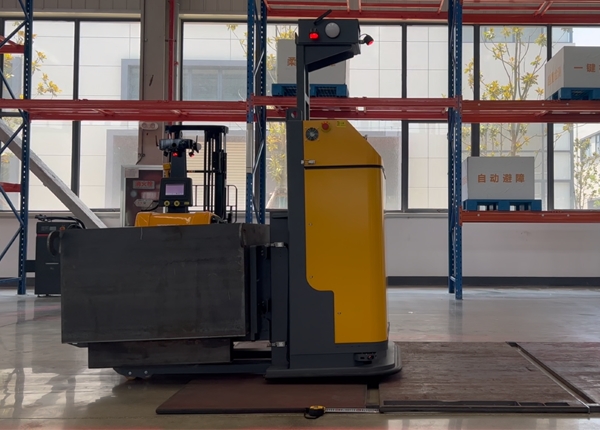
For a warehouse using Chinese AGVs, the better approach is to establish a condition-based calibration program rather than relying only on a fixed calendar interval.
The key areas to monitor are:
Steering alignment
Drive-wheel condition
Wheel diameter
Fork positioning
Lift sensors
Laser localization
IMU and odometry
Chassis geometry
Pallet pickup accuracy
There is no universal operating-hour number that applies to every Chinese automated forklift.
A calibration interval depends on factors such as:
AGV model
Navigation technology
Wheel material
Operating hours
Floor flatness
Load weight
Travel speed
Number of impacts
Tire wear
Maintenance history
A fleet operating on a smooth, flat warehouse floor may maintain its calibration significantly longer than a vehicle continuously traveling over damaged concrete or expansion joints.
Instead of specifying:
“Calibrate every 1,000 hours.”
A more practical maintenance specification is:
Inspect regularly → monitor positioning error → recalibrate when defined tolerance is exceeded.
The exact tolerance should come from the AGV manufacturer's commissioning and maintenance specifications.
Calibration drift can have both mechanical and software-related causes.
Common examples include:
Drive-wheel wear
Steering-component wear
Wheel replacement
Fork deformation
Mast alignment changes
Sensor mounting movement
Chassis impact
The localization system can also be affected by:
Changed landmarks
Rack relocation
New reflective objects
Damaged reference features
Sensor contamination
Sensor mounting displacement
This is why a positioning problem should not automatically be treated as a software problem.
Yes, depending on the vehicle's odometry architecture.
Wheel-based odometry estimates movement using wheel rotation.
If the effective wheel diameter changes because of wear, the relationship between wheel rotation and actual travel distance can change.
For example, a heavily worn drive wheel may cause the calculated travel distance to differ from the physical distance traveled.
The effect depends on how the AGV combines:
Wheel encoders
Steering angle
IMU
Laser SLAM
Other localization references
Modern autonomous forklifts can use multiple localization sources, so wheel wear does not necessarily mean the AGV immediately becomes lost.
Nevertheless, significant tire wear should trigger inspection and, where required, recalibration.
Wheel inspection should be incorporated into routine maintenance.
Look for:
Reduced tread diameter
Uneven wear
Flat spots
Cracks
Surface damage
Abnormal vibration
Steering behavior changes
A wheel replacement is particularly important because the new wheel may have a different effective diameter from the previous wheel.
After replacing critical drive or steering components, the manufacturer should specify whether encoder, steering or odometry calibration is required.
It can.
The answer depends on the AGV's mechanical and navigation design.
If a wheel replacement changes the effective rolling diameter, steering geometry or encoder relationship, the control system may need to be recalibrated.
A maintenance procedure may include:
Install the replacement wheel.
Verify mechanical alignment.
Check wheel diameter.
Verify encoder readings.
Perform steering calibration if applicable.
Run a controlled travel test.
Compare commanded and measured movement.
Confirm pallet pickup/drop-off accuracy.
The exact procedure should follow the manufacturer's service documentation.
For a Laser SLAM AGV, localization depends on the vehicle's perception of its environment and its relationship to the stored map.
A maintenance or commissioning interface may provide tools for:
Map management
Localization verification
Initial pose adjustment
Sensor calibration
Reference-point configuration
Map updates
The exact terminology and workflow differ between manufacturers.
For a warehouse with fixed racks, it is important to distinguish between sensor calibration and map updating.
They are not necessarily the same operation.
A localization reference or anchor point can provide the system with a known spatial relationship between the vehicle and the warehouse environment.
Depending on the navigation architecture, references may involve:
Natural environmental features
Reflectors
Markers
QR codes
Fixed landmarks
Rack structures
If a reference point has moved or become unreliable, the vehicle may experience increased localization error.
A proper maintenance procedure should therefore verify both:
Sensor performance
and
Map/reference-point integrity.
Look at the behavior of the AGV.
The AGV repeatedly shows a consistent offset.
For example:
Pallet pickup is consistently shifted
Fork alignment is repeatedly off by a similar amount
Steering does not track the expected path
Vehicle heading shows a repeatable error
The error occurs primarily in a particular area.
For example:
Vehicle localization becomes unstable near a modified rack
A newly installed structure changes the laser environment
One warehouse zone consistently produces localization errors
The distinction matters because recalibrating the vehicle will not necessarily solve a damaged or outdated map.
In many AGV deployments, local maintenance personnel can perform certain routine calibration procedures if the manufacturer provides the appropriate tools and training.
However, calibration should be divided into different levels.
Local technicians may typically handle:
Tire inspection
Sensor cleaning
Visual alignment checks
Fork inspection
Mechanical fastener inspection
Trained technicians may perform:
Steering calibration
Encoder checks
Sensor alignment
Basic navigation verification
Manufacturer support may be required for:
Core localization configuration
Major map reconstruction
Navigation algorithm parameters
Safety-system configuration
Significant chassis modifications
The exact authorization should be defined by the AGV supplier.
For long-term maintainability, ask the manufacturer what calibration tools are included with the system.
Useful functions can include:
Steering calibration
Encoder calibration
Sensor calibration
IMU calibration
Localization diagnostics
Map verification
Navigation accuracy testing
Fork positioning calibration
Lift-height calibration
The software should ideally show the technician whether the calibration procedure has passed or failed.
For a large AGV fleet, keeping basic maintenance capability locally can significantly reduce downtime.
Consider having:
Manufacturer-approved calibration tools
Diagnostic computer
Service software
Mechanical measuring tools
Wheel measurement equipment
Sensor-cleaning equipment
Calibration procedures
Spare sensors
Spare encoders
The objective is not necessarily to make the local team capable of changing every software parameter.
It is to allow them to diagnose common problems without waiting for an overseas engineer.
Every calibration event should be documented.
Record:
| Item | Recommended Record |
|---|---|
| AGV ID | Vehicle identification |
| Date | Calibration date |
| Operating hours | Hour meter |
| Reason | Routine / repair / wheel replacement |
| Parameter changed | Calibration item |
| Before value | Original measurement |
| After value | Final measurement |
| Technician | Person performing work |
| Test result | Pass / fail |
| Software version | Current version |
This creates a useful maintenance history for the entire fleet.
A practical program can use several triggers.
Perform the manufacturer's specified calibration after replacing critical components.
Investigate when pallet placement or pickup accuracy exceeds the project's defined tolerance.
Inspect the vehicle after a significant collision or chassis impact.
Investigate unusual steering behavior or repeated path deviation.
Inspect odometry and recalibration requirements after significant drive-wheel wear.
Verify localization after substantial rack or warehouse-layout modifications.
This approach is more useful than assuming every vehicle requires a complete calibration at an arbitrary number of operating hours.
Do not finish the process immediately after pressing “calibrate.”
Run a controlled validation test.
For example:
Start position → Travel → Stop → Pick pallet → Travel → Place pallet → Return
Measure:
Position error
Heading error
Fork alignment
Pallet placement accuracy
Repeatability
Run the test multiple times rather than relying on a single successful movement.
This confirms that the calibration works under actual operating conditions.
Add calibration requirements to the original technical specification.
Ask:
What components require calibration?
What triggers recalibration?
Is there a recommended operating-hour inspection interval?
Does wheel replacement require recalibration?
What software tools are provided?
Can local technicians perform calibration?
What training is included?
Which parameters are customer-accessible?
Which parameters require manufacturer authorization?
Can calibration records be exported?
Can the manufacturer provide remote diagnostic support?
These questions can have a major impact on long-term maintenance costs.
The most reliable approach is not to wait until an AGV becomes obviously inaccurate.
A long-term calibration lifecycle can follow:
Inspect → Measure → Diagnose → Calibrate → Validate → Record → Monitor
For an imported Chinese AGV fleet, the goal should be to make routine calibration and diagnostics possible locally while retaining manufacturer support for advanced engineering issues.
That gives the warehouse two layers of protection:
Local maintenance for routine problems + Chinese engineering support for complex problems.
This can reduce downtime and make the long-term operation of an imported autonomous forklift fleet much more predictable.
FREE ENGINEERING SUPPORT Stop Gambling on Generic Platforms. Get an AGV/AMR Tailored to Your Warehouse.Buying automated guided vehicles involves complex safety standards (CE/ANSI), navigation setups (Laser SLAM), and ERP system integration. Don't risk your factory safety with middle-men. ✓ 100% Direct Factory: Customized payload up to 5 Tons. ✓ Free CAD Simulation: Send us your layout, and our engineers will simulate the optimal AGV routes. ✓ Global Support: Overseas installation guidance & local maintenance partners. |
📖 AGV Forklift Guide — Essential manual for selection and safety.
⚙️ How AGV Systems Work — A deep dive into navigation and logic.
⚖️ AGV vs. AMR Comparison — Choosing the right technology for your facility.
💰 AGV Cost and ROI — Evaluating investment and payback periods.





 Chinese
 English