


Static electricity is easy to overlook when evaluating an autonomous forklift for a warehouse automation project.
In a dry warehouse, especially during winter or in facilities with low relative humidity, repeated movement of polyurethane wheels across certain floor surfaces can contribute to electrostatic charge buildup.
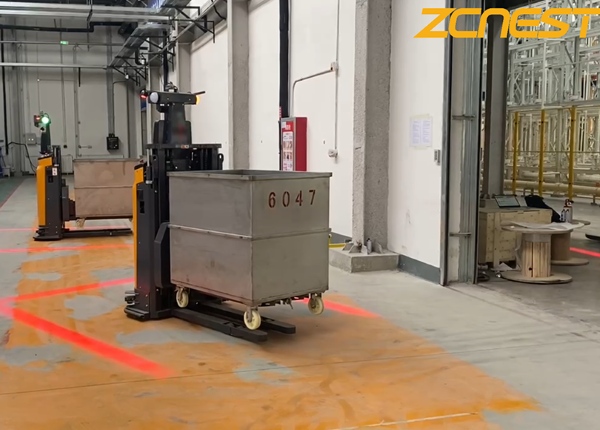
For a Chinese AGV or unmanned forklift, the issue is not simply whether the vehicle has an "anti-static" label. Procurement teams should evaluate the complete electrical design, including grounding, wheel materials, ESD protection, electrical enclosures, sensor wiring and maintenance requirements.
The key procurement question is:
How does the AGV control electrostatic charge, and what happens if an electrostatic discharge occurs?
Some industrial vehicles can use grounding or charge-dissipation components, but an anti-static chain or strap should not be assumed to be standard equipment on every Chinese AGV.
The actual solution depends on the vehicle design, wheel material, electrical architecture, floor conditions and the requirements of the application.
A supplier may address electrostatic charge through a combination of:
Conductive or dissipative wheels
Grounding components
Grounding paths within the chassis
ESD-protected electronic components
Electrical shielding
Filtering and surge protection
Appropriate cable and connector design
Do not specify "anti-static chain included" as the only acceptance criterion. Ask the manufacturer to explain the complete charge-dissipation and ESD protection design of the vehicle.
A static discharge can potentially affect electronic equipment if the discharge reaches an exposed or insufficiently protected circuit.
However, a properly designed industrial AGV should incorporate electrical protection measures so that ordinary electrostatic events do not routinely cause failures of its control electronics.
Relevant protection can include:
ESD protection at electronic interfaces
Grounding and bonding of conductive structures
Protected communication interfaces
Shielded cables where appropriate
Filtering of sensitive signal lines
Protected power inputs
Appropriate enclosure design
The important distinction is between static charge buildup and an actual electrostatic discharge event. A vehicle can accumulate charge without immediately damaging its electronics, but repeated uncontrolled discharge can create reliability problems if the electrical design does not adequately control the discharge path.
Static charge tends to become more difficult to dissipate when the surrounding environment is very dry.
Several warehouse conditions can contribute to charge accumulation:
Low relative humidity
Dry concrete or coated floors
Polyurethane or polymer wheels
Plastic pallets and containers
Synthetic packaging materials
Frequent vehicle movement
Friction between different materials
This is why static-electricity evaluation should consider the entire warehouse environment, rather than looking at the AGV alone.
Wheel material is an important part of the vehicle's electrostatic behavior.
Conventional polyurethane wheels can have relatively high electrical resistance. Depending on the formulation, manufacturers may use conductive or static-dissipative wheel materials when the application requires controlled charge dissipation.
When evaluating an AGV wheel specification, ask the supplier for:
Wheel material and formulation
Electrical resistance or resistivity information, where applicable
Whether the wheel is conductive or static-dissipative
Expected resistance range
Grounding path from the wheel to the vehicle chassis
Wheel replacement requirements
A wheel described as "anti-static" is not enough information for a technical RFQ. The buyer should understand how charge is dissipated from the contact surface through the vehicle.
Not necessarily.
Wheel wear, contamination, surface damage, replacement parts and changes in the mechanical contact path can affect the electrical characteristics of the grounding system.
For facilities where electrostatic control is critical, maintenance procedures should therefore define how grounding and dissipative components are inspected after wheel replacement or other relevant maintenance work.
In some circumstances, electrical noise or an ESD event can interfere with electronic signals or communication interfaces.
Potentially affected systems can include:
Safety scanners
Laser navigation sensors
Encoders
Proximity sensors
Camera systems
CAN or industrial communication networks
Control-board inputs
However, this does not mean that the AGV's software normally identifies an event and displays a message saying "static electricity detected." In many systems, the primary protection occurs at the hardware and electrical-design level.
This depends heavily on the vehicle's control architecture.
Fleet software may be able to identify indirect symptoms such as:
Repeated sensor communication faults
Abnormal encoder feedback
Communication timeouts
Unexpected controller resets
Repeated safety-device faults
Abnormal sensor data
These symptoms can indicate an electrical or communication problem, but they do not necessarily prove that static electricity was the cause.
Software diagnostics can identify abnormal behavior. They generally cannot replace proper ESD protection, grounding and electrical validation.
If static electricity is a known risk at the warehouse, include ESD-related questions directly in the RFQ.
| RFQ Item | What to Confirm |
|---|---|
| Wheel material | Conductive, static-dissipative or conventional material |
| Grounding path | How charge is dissipated from the vehicle |
| ESD protection | Protection used on sensitive electronics and interfaces |
| Sensor protection | Protection of navigation and safety-related electronics |
| Diagnostic capability | Available fault logs and communication diagnostics |
| Testing | Applicable ESD or EMC validation performed on the exact model |
| Maintenance | Grounding inspection after wheel or electrical maintenance |
The AGV should be evaluated under conditions that represent the actual warehouse.
Actual warehouse floor material
Actual floor coating
Typical warehouse humidity
Representative pallet materials
Actual wheel configuration
Normal travel speeds
Typical charging and operating conditions
If the warehouse uses large amounts of plastic packaging, plastic pallets or synthetic materials, these should also be considered during the evaluation because electrostatic behavior depends on the interaction between multiple materials.
For a procurement project where static electricity is a significant concern, ESD requirements should not remain as a verbal promise.
During factory acceptance testing or site acceptance testing, the buyer can define measurable requirements around:
Grounding continuity
Wheel electrical characteristics where specified
Electrical fault behavior
Sensor communication stability
Controller reset behavior
Applicable ESD or EMC test requirements
The exact test method and acceptance limits should be agreed with the manufacturer based on the vehicle architecture, applicable standards and the warehouse application.
Severe static electricity should be treated as a system-level engineering issue, not simply a wheel or software problem.
A practical procurement process is:
Warehouse Conditions → Wheel Material → Grounding Design → ESD Protection → Electrical Diagnostics → FAT/SAT Verification → Maintenance Inspection
For warehouses with very dry conditions or strict electrostatic-control requirements, the buyer should provide the manufacturer with the actual floor, humidity, pallet and operating conditions before the AGV is finalized. This allows the supplier to determine whether standard wheels and grounding are sufficient or whether a dedicated static-dissipative configuration is required.
📖 AGV Forklift Guide — Essential manual for selection and safety.
⚙️ How AGV Systems Work — A deep dive into navigation and logic.
⚖️ AGV vs. AMR Comparison — Choosing the right technology for your facility.
💰 AGV Cost and ROI — Evaluating investment and payback periods.





 Chinese
 English