


High-Bay Warehouse Automation Guide
Selecting a three-way forklift AGV requires more than checking maximum lift height and rated load capacity. Warehouse aisle geometry, pallet dimensions, rack clearance, load stability, task frequency, and control-system integration all affect whether the vehicle can operate reliably in a high-bay storage environment.
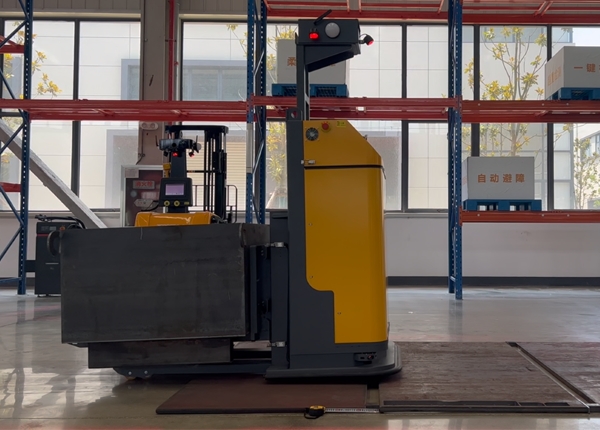
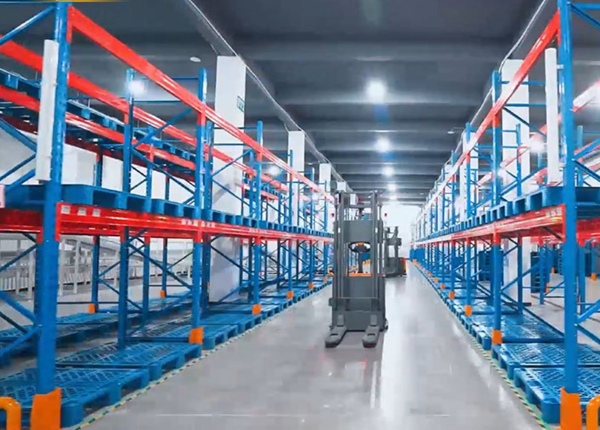
A three-way forklift AGV is designed to handle pallets in narrow aisles by positioning its forks to the left or right without requiring the entire vehicle to turn toward each rack location. This operating principle can support higher storage density, but only when the vehicle and warehouse layout are designed to work together.
Before comparing models, collect the actual dimensions of the operating area rather than relying only on the warehouse construction drawings.
Measure clear aisle width between the closest rack or load obstructions.
Record rack beam elevations, maximum storage height, and the required fork insertion depth.
Check pallet length, width, entry direction, bottom-board design, and overhang.
Identify columns, fire equipment, safety barriers, floor joints, charging areas, and cross-aisle turning points.
Confirm the available space for pallet pickup, placement, and recovery when a task fails.
The critical measurement is not simply the distance between rack uprights. The usable aisle must accommodate the vehicle, pallet, load overhang, navigation tolerances, and the manufacturer's operating clearances.
PARAMETER 01
Confirm the minimum operating aisle under the actual pallet and rack configuration. Ask the supplier to clarify the measurement conditions behind its quoted minimum aisle width.
PARAMETER 02
Rated load capacity at a low lift height does not automatically mean the same load can be handled at the highest rack level. Request the load-capacity information for the intended lift height and load center.
PARAMETER 03
Verify fork dimensions, fork spacing, insertion clearance, pallet condition, and the stability of the load during lifting and placement.
PARAMETER 04
The vehicle must localize reliably and position the forks accurately under real warehouse conditions. Rack alignment, reflective surfaces, floor conditions, and load variation should be included in testing.
PARAMETER 05
Evaluate the complete pallet cycle, including travel, lifting, fork positioning, loading, unloading, and waiting. A fast vehicle cannot compensate for poorly coordinated task assignment or congested transfer points.
Warehouse buyers often compare AGVs by travel speed or maximum lift height. Neither figure alone indicates how many pallets the system can process per shift.
Break the operating cycle into measurable activities:
Travel from the starting point to the assigned storage location.
Align the vehicle and position the forks.
Pick up or place the pallet at the required height.
Confirm task completion and update the inventory or warehouse system.
Travel to the next task, charging point, or waiting location.
Estimate the required moves per hour and per shift, then test the model against peak periods rather than average daily volume alone. Include empty travel, charging, operator intervention, and waiting caused by blocked locations.
A three-way forklift AGV is part of a warehouse operating system, not an isolated vehicle. Before purchase, clarify which system creates transport tasks, assigns storage locations, manages vehicle traffic, and confirms inventory movements.
Can the fleet control system exchange task data with the existing WMS or WCS?
How are unavailable locations, failed pickups, and inventory discrepancies handled?
Can operators view task status, vehicle alarms, and movement history?
What happens when the warehouse network or an upstream system is interrupted?
Who is responsible for interface development, testing, and production acceptance?
Agree on interface responsibilities and error-handling rules before the vehicle arrives. This reduces the risk of completing mechanical installation while the warehouse workflow remains unusable.
Use representative pallets and the intended storage heights to test pickup, placement, positioning accuracy, cycle time, traffic coordination, charging, safety functions, and system communication. Define measurable acceptance criteria before signing the purchase contract, including how exceptions and failed tasks will be recorded.
📖 AGV Forklift Guide — Essential manual for selection and safety.
⚙️ How AGV Systems Work — A deep dive into navigation and logic.
⚖️ AGV vs. AMR Comparison — Choosing the right technology for your facility.
💰 AGV Cost and ROI — Evaluating investment and payback periods.












 Chinese
 English





