


Warehouse Software Integration Guide
For overseas warehouse operators purchasing AGV forklifts from China, software integration is a major part of project planning. The vehicles must execute transport tasks while the existing warehouse and enterprise systems retain control of inventory, business orders, and operational records. This guide explains the integration responsibilities and technical questions buyers should resolve before ordering.
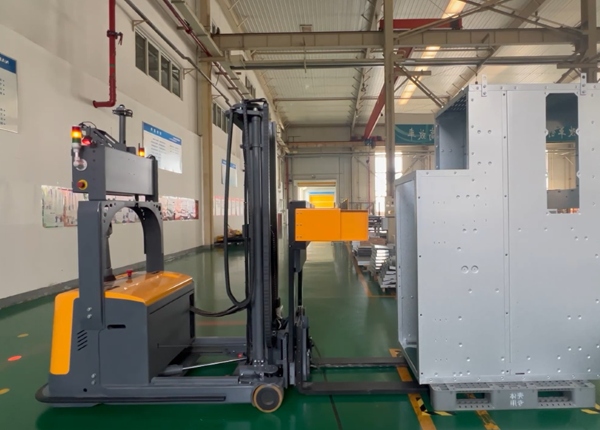
An AGV project may involve SAP or another ERP, a warehouse management system, warehouse control software, and an AGV fleet management system. These platforms have different responsibilities, and the exact architecture depends on the customer's existing software and the automation supplier's capabilities.
In many projects, the ERP manages business transactions, the WMS manages inventory and warehouse tasks, and the fleet management system dispatches vehicles and coordinates their movements. A WCS may coordinate conveyors or other material-handling equipment where required.
ERP: Maintains relevant business orders and enterprise transaction records.
WMS: Manages inventory locations, warehouse tasks, and stock movement rules.
WCS: Coordinates connected material-handling equipment where included in the architecture.
AGV fleet management: Assigns transport tasks to vehicles, coordinates traffic, and reports execution status.
Do not assume that every project requires all four systems or that each supplier uses the same architecture. The important requirement is to define which system owns each decision and which system is responsible for confirming a completed physical movement.
LAYER 01
Specify how a business order becomes a warehouse task, which pallet or load must move, and how the destination is assigned. Define the identifiers used to track the task across systems.
LAYER 02
The fleet system receives an executable task and manages vehicle assignment, routing, traffic coordination, and task progress. The interface must distinguish an accepted task from one that has actually been completed.
LAYER 03
After a movement, the system returns a status that allows the responsible warehouse application to update the task and inventory record. Failed pickups, blocked destinations, and interrupted tasks must be handled without creating false completion records.
The interface specification should describe the data exchanged, its format, when messages are sent, and what happens when a message fails. A general statement that the AGV supports WMS integration is not enough to establish project compatibility.
Unique task or order identifier.
Pickup and destination locations.
Pallet or load identifier, where applicable.
Task priority and permitted execution conditions.
Required handling type or other task-specific instructions.
Task accepted, rejected, started, completed, or failed.
Current task stage and relevant timestamps.
Vehicle or equipment status when required by the interface.
Error codes and information needed for recovery.
Confirmation of pickup or delivery when supported by the system.
These fields are examples rather than a universal interface standard. The final message structure and available status information must be agreed between the customer's software team and the AGV supplier.
SAP and WMS deployments differ by product, version, customization, hosting model, and existing middleware. Buyers should confirm the actual integration method with the teams responsible for the current systems instead of assuming that a particular connector or protocol is available.
Which APIs, protocols, or middleware options are supported by the proposed fleet system?
Is interface documentation available for review before the project begins?
Who develops and maintains the interface between the WMS and fleet system?
Which network access, firewall rules, and security approvals are required?
How are authentication, access permissions, logging, and interface errors managed?
Who provides the test environment and validates end-to-end transactions?
Document responsibilities for the customer, software provider, AGV manufacturer, and any integration partner. This prevents a common project delay in which each party assumes another team will complete a required interface.
A successful demonstration proves that a basic movement can be executed. Production readiness also depends on what happens when the workflow encounters errors or interruptions.
Duplicate task request: The system should avoid unintentionally executing the same business movement twice.
Unavailable destination: The task should be held, redirected, or escalated according to an agreed rule.
Communication failure: The systems should recover and reconcile task status without losing track of the physical pallet.
Vehicle fault: The task should remain visible and follow a defined reassignment or recovery process.
Manual intervention: The physical action and inventory record should be reconciled before the task is closed.
Prepare the WMS or ERP product and version, system architecture, task examples, location naming rules, interface documentation, network restrictions, and the expected pallet workflow. The more clearly these requirements are defined, the easier it is to estimate development work, assign responsibilities, and create a realistic commissioning plan.
📖 AGV Forklift Guide — Essential manual for selection and safety.
⚙️ How AGV Systems Work — A deep dive into navigation and logic.
⚖️ AGV vs. AMR Comparison — Choosing the right technology for your facility.
💰 AGV Cost and ROI — Evaluating investment and payback periods.












 Chinese
 English





