


Narrow Aisle Warehouse Selection Guide
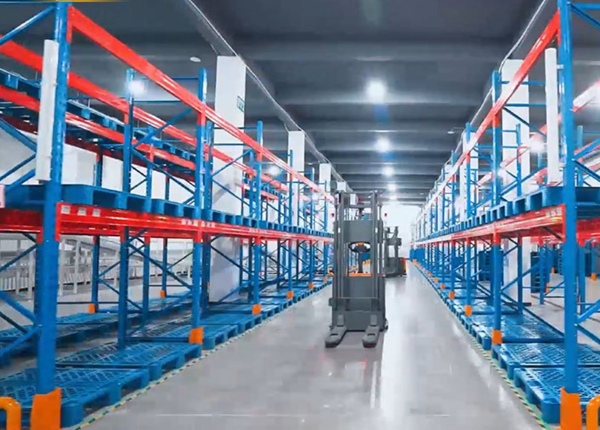
Narrow aisle warehouse automation is a space-planning decision as much as a vehicle-selection decision. The right AGV forklift must fit the actual aisle geometry, handle the required pallet at the intended storage height, and maintain reliable positioning throughout repeated storage and retrieval cycles. This guide explains how to evaluate those requirements before purchasing.
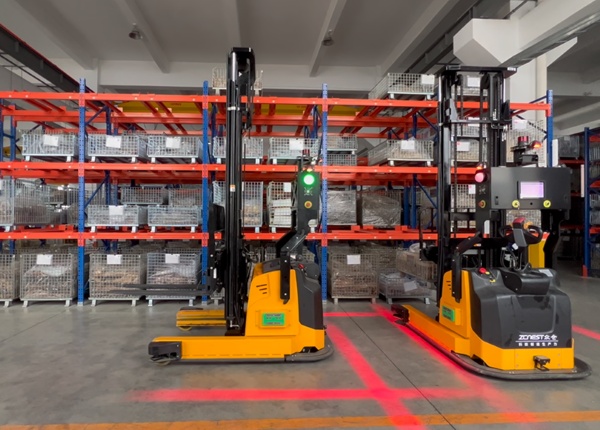
The aisle width shown on a warehouse drawing may not represent the space available during actual operations. Rack projections, pallet overhang, structural columns, protective barriers, and load-position variation can reduce the usable clearance.
Before selecting a vehicle, measure the narrowest operating points and confirm how the supplier defines its minimum aisle requirement. A specification may depend on pallet dimensions, load orientation, vehicle configuration, and the required operating clearances.
Measure clear width between the closest rack or load obstructions.
Record pallet dimensions and the maximum expected load overhang.
Identify cross aisles, turning areas, transfer points, and emergency access routes.
Check the space needed for fork insertion and withdrawal at storage locations.
Confirm whether aisle clearance changes when pallets are stored in adjacent rack positions.
Do not select a vehicle solely because its body width is smaller than the aisle. The complete operating configuration must provide sufficient clearance for the vehicle, pallet, load, and intended maneuver.
SPECIFICATION 01
Ask for the minimum aisle requirement under your actual pallet and handling conditions. Confirm the measurement method and the required clearance at the narrowest points.
SPECIFICATION 02
Match the highest required storage position and maximum load to the vehicle's permitted capacity at the relevant lift height and load center.
SPECIFICATION 03
Verify fork length, spacing, thickness, insertion depth, pallet entry direction, and load stability. A mismatch can cause failed pickups or unsafe handling even when the rated capacity is sufficient.
SPECIFICATION 04
Evaluate the vehicle's ability to reach rack locations and position its forks consistently under real floor, lighting, and rack conditions. Request a test using representative pallets and target locations.
Not every narrow aisle application requires the same forklift design. A standard counterbalanced vehicle, reach-style forklift, stacker AGV, or three-way forklift AGV may suit different handling tasks. The correct choice depends on the required maneuver, storage height, pallet type, and warehouse layout.
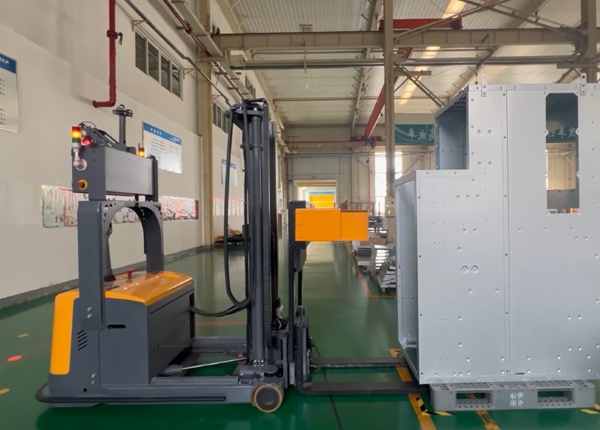
A three-way forklift AGV can position its forks to handle pallets on either side of a narrow aisle without requiring the whole vehicle to turn toward every rack position. This can support high-density storage when the rack arrangement, pallet dimensions, and operating clearances match the vehicle's design.
Reach-style and stacker configurations may suit other storage layouts where the required reach, load handling, aisle dimensions, and turning movements are compatible with the vehicle. Compare the complete operating envelope rather than selecting by product name alone.
Request a layout-based recommendation that explains why a particular vehicle type fits the intended operation. If more than one design is technically feasible, compare throughput, storage density, integration requirements, and maintenance access.
A narrow aisle can increase storage density but also create a shared resource that must be managed carefully. If several AGVs need to enter the same aisle, traffic rules and task scheduling may affect throughput more than individual vehicle speed.
Calculate the complete cycle time, including travel, fork positioning, lifting, load placement, task confirmation, and return movement. Identify locations where vehicles must wait for a task to finish before entering or crossing a restricted aisle.
Estimate peak putaway and retrieval tasks per hour.
Identify aisles or transfer stations likely to become bottlenecks.
Include charging, planned downtime, and exception recovery in capacity planning.
Confirm how the fleet system reserves aisles and coordinates vehicle movement.
Validate the design using representative peak-demand scenarios.
High-density storage depends on consistent physical conditions. Rack alignment, floor flatness, joint transitions, lighting, and the condition of pallets can affect repeatable positioning and safe load handling.
Inspect the route for pedestrian crossings, manual forklift traffic, staging areas, and emergency access. Agree on how the AGV responds to obstacles and how operators can recover a blocked or failed task without creating a conflict in the aisle.
Ask the supplier to identify the site conditions required for reliable operation and the measurements needed during commissioning. Where the warehouse has existing equipment or a WMS, define the required interfaces and task confirmation rules before finalizing the scope.
Send the supplier your rack drawings, minimum aisle width, pallet dimensions, maximum load, required lifting height, floor information, and target throughput. Ask for a model recommendation, the operating clearances used in the assessment, and a clear list of conditions that must be verified before acceptance.
📖 AGV Forklift Guide — Essential manual for selection and safety.
⚙️ How AGV Systems Work — A deep dive into navigation and logic.
⚖️ AGV vs. AMR Comparison — Choosing the right technology for your facility.
💰 AGV Cost and ROI — Evaluating investment and payback periods.












 Chinese
 English





