


WAREHOUSE EQUIPMENT SELECTION GUIDE
Pallet dimensions, bottom-deck design, load stability, and fork-entry clearance can determine whether an autonomous forklift handles warehouse goods reliably. Verify these details before selecting equipment.
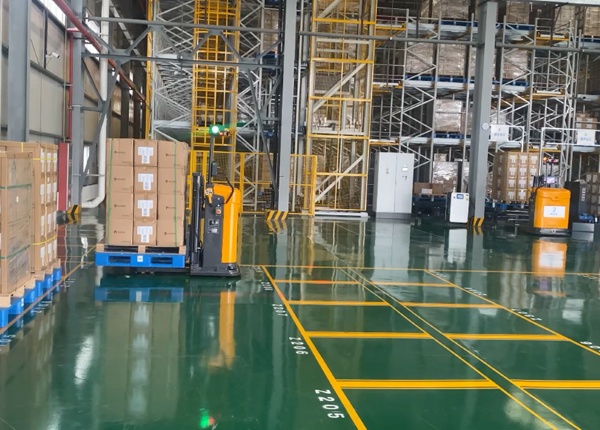
An AGV forklift must do more than reach a pallet. It must approach the load, enter the fork openings, lift the pallet without damaging it, transport the load within stability limits, and place it at the intended destination. A pallet that works with a manual forklift may not be suitable for every autonomous forklift configuration.
Problems often appear when a warehouse uses several pallet types, damaged pallets, non-standard skids, or loads that overhang the pallet footprint. These variations can affect fork entry, positioning accuracy, load stability, and the reliability of automated pickup and placement.
Before requesting a quotation, document the pallet types used in daily operations and identify the most difficult examples, not just the newest or most uniform pallets.
Record pallet length, width, overall height, bottom clearance, and the dimensions and positions of fork openings. Include the pallet's orientation at pickup and whether the AGV must access it from the long side, short side, or both.
Overall dimensions: Confirm the minimum, maximum, and most common pallet sizes.
Fork opening: Measure usable opening height and width, including any obstructing deck boards.
Entry direction: Specify the permitted approach sides and pallet orientation.
Bottom deck: Identify blocks, runners, crossboards, and gaps that may obstruct the forks.
Load overhang: Measure goods extending beyond the pallet edges.
Nominal pallet dimensions alone are not enough. The usable fork-entry space can differ because of pallet construction, wear, deformation, or repairs. Provide physical samples or detailed photographs to the supplier whenever possible.
Maximum load weight is only one part of the handling requirement. The load's center of gravity, height, shape, and distribution influence the vehicle's permitted lifting and travel conditions.
For each load category, record the gross weight, dimensions, stacking height, and whether the contents can shift during transport. Long, tall, uneven, or loosely wrapped loads may require specific handling rules even when their total weight is below the forklift's rated capacity.
Ask the supplier to confirm the rated capacity at the required lift height and load center. Do not assume that the maximum rated capacity applies at every lifting height or with every attachment.
Wooden, plastic, and metal pallets can present different pickup conditions. Wooden pallets may have broken boards, protruding nails, or inconsistent dimensions. Plastic pallets may have molded supports or flexible sections. Metal pallets may have unusual openings, low-clearance structures, or non-standard contact surfaces.
Define which conditions the automated system must accept and which should be rejected. If damaged pallets are common, decide whether workers will inspect them before pickup or whether the system needs a separate detection and exception-handling process.
A practical test should include representative pallets from actual warehouse operations, including the least favorable acceptable examples. Testing only a perfect sample may hide issues that appear after deployment.
DIMENSIONS AND ACCESS
Pallet length and width, fork opening, bottom clearance, entry direction, and load overhang.
LOAD CHARACTERISTICS
Gross weight, load center, height, stability, wrapping condition, and product fragility.
EXCEPTIONS AND VARIATIONS
Damaged pallets, mixed pallet types, misaligned loads, and rules for rejecting unsuitable loads.
Use this checklist to create a shared specification for the warehouse team, equipment supplier, and system integrator. Every required pallet category should be explicitly included in the validation plan.
Pallet compatibility must be evaluated together with the destination equipment. A pallet may be picked up successfully but still be unsuitable for a rack opening, conveyor transfer, lift table, or automated storage interface.
Check the clear width and height of rack locations, required placement tolerances, load overhang restrictions, and any support requirements. For conveyor or transfer-station interfaces, confirm the pallet's support surfaces and the exact position where the load will be handed over.
If multiple pallet types share a destination, determine whether all are accepted or whether the system must direct certain pallets to designated locations. These rules should be reflected in warehouse task logic and operational procedures.
Before approving a final configuration, request a handling test using representative pallets and loads. The test should cover approach, fork entry, lifting, loaded travel, positioning, unloading, and recovery from unsuccessful pickup attempts where applicable.
Provide actual pallet samples and load specifications.
Include minimum and maximum load dimensions and weights.
Test the required pickup and placement orientations.
Record successful handling, exceptions, and any pallet damage.
Agree on acceptable operating conditions and rejection rules.
Document which pallet types are approved for routine operation.
A clear compatibility specification reduces uncertainty during equipment selection and commissioning. It also helps prevent later disputes about whether the system was designed to handle a particular pallet or load condition.
Share your pallet dimensions, gross load weights, fork-entry details, lifting height, and rack or transfer-station requirements. ZCNest can help assess suitable AGV forklift configurations for your warehouse handling conditions.
📖 AGV Forklift Guide — Essential manual for selection and safety.
⚙️ How AGV Systems Work — A deep dive into navigation and logic.
⚖️ AGV vs. AMR Comparison — Choosing the right technology for your facility.
💰 AGV Cost and ROI — Evaluating investment and payback periods.












 Chinese
 English





