


WAREHOUSE STORAGE ENGINEERING GUIDE
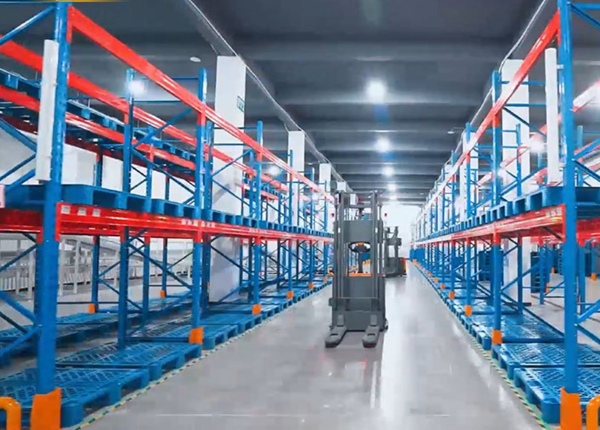
Selecting an AGV forklift for an existing storage system requires more than checking lifting height. Rack clearances, pallet positions, aisle geometry, floor conditions, and placement tolerances must work together.
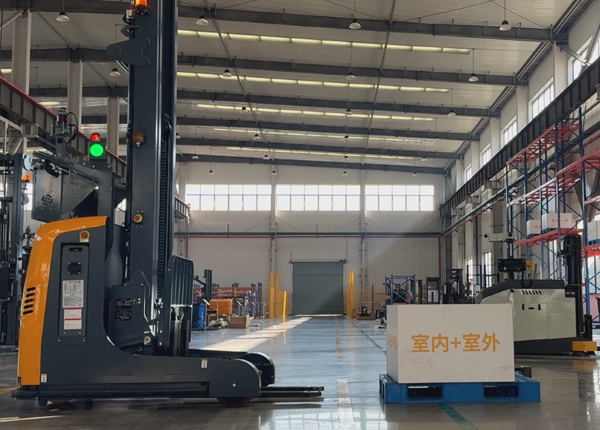
An AGV forklift may have sufficient rated capacity and lift height but still be unsuitable for a particular rack installation. The deciding factors can include the available aisle width, clear opening dimensions, pallet overhang, beam positions, floor flatness, and the accuracy required for placement.
Start by obtaining the rack layout and technical drawings. If these are unavailable or no longer reflect the actual site, measure the operating area directly. Include rack uprights, protective barriers, fire equipment, columns, doors, and other objects that reduce usable clearance.
The goal is to confirm that the proposed vehicle can approach, lift, travel, and place the load within the real operating envelope—not merely within nominal warehouse dimensions.
Aisle width must be evaluated in relation to the selected forklift model, pallet dimensions, load orientation, and maneuvering method. The aisle measurement should reflect the actual clear space available during operation rather than the distance between nominal rack centerlines.
Conventional counterbalanced forklifts, reach trucks, stacker-type AGVs, and omnidirectional forklift systems have different maneuvering characteristics. A vehicle designed for narrow-aisle operation may reduce the required aisle envelope, but the achievable result depends on the specific configuration and handling task.
Measure the narrowest clear aisle section.
Include rack guards, columns, and other fixed obstructions.
Check turning areas and end-of-aisle maneuvering space.
Verify the approach needed to enter and exit each rack location.
Consider loaded and unloaded movement separately.
Do not use a generic minimum aisle figure as a final design guarantee. Request the selected model's technical layout and verify it with the intended pallet and rack geometry.
The required lifting height should be based on the actual pallet support level at the highest intended storage position. Rack beam elevation, pallet height, load height, overhead clearance, and the vehicle's lifting configuration all affect the final selection.
Also verify whether the vehicle can reach the target level while maintaining the required load capacity and stability. A forklift's maximum lifting height and maximum rated load should not automatically be assumed to apply simultaneously.
Where loads vary in height, consider the tallest permitted load and the available clearance above it. Include lighting, sprinklers, structural elements, and other overhead restrictions in the site assessment.
Automated storage requires consistent placement at the destination. The acceptable positioning range depends on pallet dimensions, rack opening geometry, load overhang, and the clearances provided by the storage system.
Rack uprights may be slightly out of alignment, floors may have local irregularities, and pallets may not be perfectly square. These real-world variations should be considered when defining the placement strategy and validation requirements.
Ask the supplier to explain how the vehicle approaches the rack, detects or references the placement position, and confirms successful load transfer. If special rack interfaces or positioning aids are required, include them in the project scope before comparing quotations.
GEOMETRY
Aisle width, turning space, rack opening, uprights, guards, and approach angles.
LOAD AND LIFTING
Pallet footprint, maximum load height, gross weight, load center, and lift requirements.
PLACEMENT CONDITIONS
Required positioning accuracy, floor conditions, pallet variation, and load-transfer confirmation.
Complete this review using the actual rack drawings and selected vehicle configuration. Any assumptions that remain unverified should be recorded as items to resolve during site assessment or testing.
Floor conditions affect vehicle movement, localization, braking, and load handling. Check floor joints, uneven surfaces, slopes, drainage channels, expansion joints, and transitions between warehouse zones.
A route that crosses a ramp, threshold, dock area, or damaged floor section should be reviewed against the vehicle's operating limits. Floor flatness and levelness requirements may be particularly important for high-lift operations because small surface variations can influence load positioning at elevation.
Request the supplier's floor requirements for the intended model and application. Where repairs or surface improvements are necessary, establish responsibility and completion timing before installation.
A site validation should demonstrate the intended vehicle performing representative rack operations under realistic conditions. Include the most demanding rack level, the narrowest aisle, typical pallet variations, and any locations with restricted approach space.
Test pickup and placement at representative rack heights.
Confirm clearance around rack uprights and protective structures.
Verify handling with the approved pallet and load range.
Check route transitions and stopping positions.
Record failed placements, manual interventions, and corrective actions.
Document approved operating areas and any site restrictions.
The final equipment decision should be based on the demonstrated operating envelope and agreed acceptance criteria, not on the lifting height or aisle-width specification alone.
Provide your rack layout, aisle measurements, maximum storage height, pallet dimensions, and load weights. ZCNest can help review the handling requirements and identify the vehicle specifications that need to be validated.
📖 AGV Forklift Guide — Essential manual for selection and safety.
⚙️ How AGV Systems Work — A deep dive into navigation and logic.
⚖️ AGV vs. AMR Comparison — Choosing the right technology for your facility.
💰 AGV Cost and ROI — Evaluating investment and payback periods.












 Chinese
 English





