


WAREHOUSE AUTOMATION IMPLEMENTATION GUIDE
Mixed fleets can help warehouses automate selected transport tasks without replacing every manual forklift at once. Successful deployment depends on route design, traffic rules, task allocation, and clearly defined safety procedures.
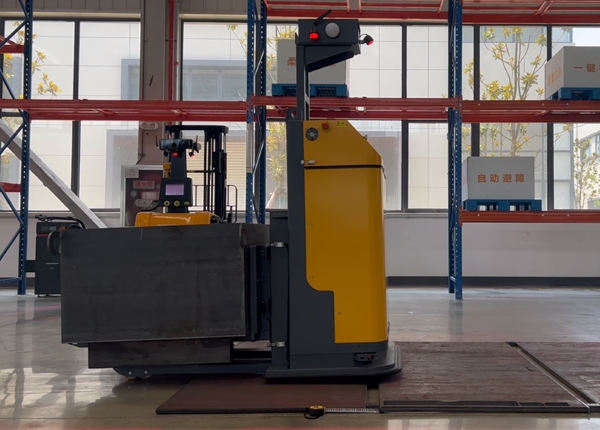
A mixed fleet is most effective when autonomous and manual equipment have clearly defined roles. Repetitive, predictable pallet movements between fixed warehouse locations are often easier to automate than tasks involving frequent changes in load shape, destination, or handling method.
Start by mapping current forklift movements. Record origin and destination, frequency, travel distance, load type, operating time, and the reason manual intervention is required. Identify routes with stable pickup and drop-off conditions that can be standardized for AGV operation.
Manual forklifts can remain responsible for irregular loads, exception handling, temporary storage, and tasks requiring operator judgment. The exact division depends on the warehouse's operating model and the capabilities of the selected equipment.
Mixed-fleet operation introduces interactions between autonomous vehicles, manually driven forklifts, pedestrians, and other warehouse equipment. A route that works well for an isolated AGV may become inefficient or unsuitable when shared with manual traffic.
Classify the warehouse into operating zones. These may include AGV-only routes, shared transport aisles, manual handling areas, pedestrian crossings, loading points, and restricted-access zones. Each zone should have defined movement rules and responsibilities.
Identify shared intersections and narrow passages.
Define right-of-way rules and permitted travel directions.
Establish controlled crossing points for pedestrians.
Prevent staging pallets from blocking designated routes.
Specify how temporary obstacles and stopped vehicles are managed.
Traffic rules must be supported by the site's physical layout, operating procedures, and applicable safety requirements. Vehicle sensing functions do not replace the need to design safe routes and manage human behavior.
Mixed fleets can create operational confusion when a task is not clearly assigned. For example, an AGV may arrive at a transfer point while a manual forklift is still placing a pallet there, or two systems may attempt to move the same load.
Define the trigger that starts each task, the equipment responsible for it, the location where the task is considered complete, and the conditions for exception handling. Where a manual forklift transfers a pallet to an AGV, establish the required load position and how the system confirms that the pallet is ready.
If warehouse software assigns tasks, confirm how the system prevents duplicate assignments, handles failed handovers, and reports task status. If the process relies on operator input, make the required confirmation steps clear and practical.
The main limitation in a mixed fleet is not always vehicle capacity. Congested intersections, shared aisles, loading bays, and transfer stations can restrict the flow of both manual and autonomous vehicles.
Measure how often these areas are occupied and how long vehicles wait. If an AGV must repeatedly stop for manual traffic, its effective throughput may be lower than the original cycle-time estimate. Conversely, reserving an aisle exclusively for AGVs may reduce flexibility for manual operations.
Review traffic data before deciding whether to add vehicles, change routes, move handover points, or adjust task scheduling. Improving the bottleneck can deliver better results than increasing the fleet size alone.
AUTONOMOUS TRANSPORT ZONES
Standardized routes, repeatable pickup and drop-off points, and tasks suited to autonomous handling.
MANUAL HANDLING ZONES
Irregular loads, exceptions, temporary moves, and operations that require direct operator control.
CONTROLLED HANDOVER ZONES
Clearly marked transfer positions with defined task ownership and load-ready confirmation.
The objective is not simply to separate equipment physically. It is to establish an operating model in which people, manual forklifts, and AGVs can complete their assigned tasks without creating avoidable conflicts.
Where AGVs are managed through a fleet-control system and the warehouse uses a WMS or WCS, the task flow should be agreed before deployment. Determine which system creates the task, which system assigns the vehicle, and which system records completion.
Manual forklift activities may need to be represented in the same workflow when they affect inventory movement or task readiness. Examples include confirming that a pallet has arrived at a transfer point or recording that a manual operator has completed a prerequisite operation.
Specify how the systems handle communication failures, canceled tasks, unavailable destinations, and duplicate requests. Clear exception handling prevents unresolved tasks from accumulating in the dispatch queue.
Introducing AGVs changes how operators interact with the warehouse. Staff should understand designated routes, handover procedures, emergency response, obstacle reporting, and the limits of autonomous equipment.
Before full operation, test the actual shared environment rather than validating the AGV only in an empty aisle. Include representative traffic levels, pedestrian crossings, manual forklift movements, and realistic task handovers.
Document traffic and pedestrian rules.
Test routine tasks and exception scenarios.
Verify task ownership and completion reporting.
Measure waiting time and throughput at shared bottlenecks.
Train operators on approved intervention procedures.
Review incidents and update operating procedures before expansion.
A staged rollout allows the warehouse to correct traffic and process issues before more routes or vehicles are introduced.
Share your warehouse layout, existing forklift routes, pallet movement tasks, and software environment. ZCNest can help assess which warehouse transport operations may be suitable for AGV automation and what should be validated before rollout.
📖 AGV Forklift Guide — Essential manual for selection and safety.
⚙️ How AGV Systems Work — A deep dive into navigation and logic.
⚖️ AGV vs. AMR Comparison — Choosing the right technology for your facility.
💰 AGV Cost and ROI — Evaluating investment and payback periods.












 Chinese
 English





