


CHARGING INFRASTRUCTURE PLANNING
Charging location affects vehicle travel, congestion, access, and operational continuity. Learn how to evaluate charging areas as part of your warehouse layout and fleet operating plan.
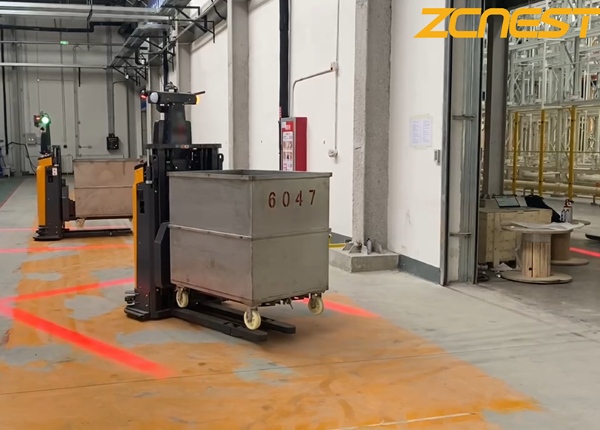
Charging stations are often treated as an equipment detail after the vehicle layout has been decided. In practice, their location can affect route efficiency, traffic flow, maintenance access, and the availability of vehicles during busy operating periods.
The best arrangement depends on the vehicle's charging method, the operating schedule, the available building space, and the expected distribution of transport tasks. Charging should therefore be considered alongside fleet capacity and warehouse traffic planning.
Confirm the selected vehicle's charging requirements before reserving floor space. Different models may use different charging interfaces, connection arrangements, or operating procedures.
Ask the supplier to confirm the charging equipment footprint, required clearances, electrical requirements, connection method, and any restrictions on the surrounding environment. Also establish whether charging is scheduled, performed during planned breaks, or triggered when the vehicle reaches a defined battery state.
Do not assume that charging arrangements used by one vehicle model will be suitable for another. The charging station design should follow the selected equipment specifications and the site's electrical and safety review.
A centralized charging area can simplify supervision, electrical installation, and maintenance access. However, vehicles may need to travel farther to reach it, and multiple vehicles could compete for limited charging positions.
Distributed charging locations may reduce travel from remote operating zones, but they can increase infrastructure complexity and require more careful control of access and maintenance. They may also occupy space that could otherwise be used for staging or transport.
Compare the options using actual travel paths, fleet size, charging duration, task demand, and the space available. The decision should be based on the operating scenario rather than a universal preference for one layout.
Vehicles entering or leaving a charging position should not create unnecessary obstruction at narrow aisles, intersections, or busy transfer points. Map the approach and departure paths and review how other vehicles will pass the charging area.
Check whether a vehicle waiting for a charging position could block an aisle or prevent another vehicle from completing a critical task. If necessary, define a separate waiting position or a rule that prevents vehicles from queuing in active traffic lanes.
Also review pedestrian movement around the charging area. Access for inspection and maintenance should not require people to cross an uncontrolled vehicle route or enter a restricted area without following the site's safety procedure.
Charging infrastructure must support the expected fleet duty cycle. Review how many vehicles are likely to require charging during the same time window, how long they remain unavailable, and whether the warehouse can tolerate a temporary reduction in available vehicles.
Use the supplier's charging data and the warehouse's expected task demand to model this relationship. Include shift patterns, peak transport periods, planned breaks, and any charging restrictions that apply to the selected equipment.
Do not estimate the required number of charging positions from fleet size alone. A larger fleet may have staggered charging needs, while a smaller fleet operating continuously may require a different arrangement. Confirm the proposed design against the actual operating assumptions.
Confirm the available electrical capacity and the installation requirements for each charging position. The site's electrical team should review circuit protection, cabling, isolation, and other requirements applicable to the selected charging equipment.
Assess the surrounding environment, including temperature, dust, moisture, possible impact from material-handling equipment, and the risk of objects being stored too close to the station. Keep the area accessible for inspection and maintenance.
Mark the charging footprint and required clearance on the warehouse layout. If the charging area is near racks, pedestrian routes, emergency exits, or staging areas, verify that the proposed position does not compromise access or create a new operational conflict.
The fleet control system and warehouse operating procedures should define when a vehicle may leave work to charge, how charging positions are assigned, and what happens when all positions are occupied.
Agree on the conditions for returning to work after charging, including any required status checks or charging confirmation. The exact rules depend on the vehicle and battery system, but they should be documented and tested before routine operation.
Review how charging tasks interact with urgent warehouse movements. If a vehicle is assigned to a critical task, the system should follow an agreed policy rather than making an undocumented decision that could affect shipment or replenishment commitments.
Test the complete process: vehicle approach, docking or connection, charging status confirmation, departure, and return to the task queue. Include scenarios where the station is occupied or unavailable and verify that the vehicle does not block an active route while waiting.
EQUIPMENT — Charging requirements are confirmed for the selected vehicle.
LAYOUT — Approach, departure, and maintenance clearances are available.
CAPACITY — Charging demand is checked against the operating schedule.
TRAFFIC — Queues do not block aisles or critical transfer points.
CONTROL — Charging, availability, and recovery rules are tested.
Charging station placement should be evaluated as part of the complete fleet operating plan. A suitable layout balances travel distance, charging access, electrical requirements, traffic flow, and the number of vehicles available during peak demand.
ZCNest can review your warehouse layout, operating schedule, and selected AGV forklift requirements to discuss charging-area planning and fleet availability considerations.
📖 AGV Forklift Guide — Essential manual for selection and safety.
⚙️ How AGV Systems Work — A deep dive into navigation and logic.
⚖️ AGV vs. AMR Comparison — Choosing the right technology for your facility.
💰 AGV Cost and ROI — Evaluating investment and payback periods.














 Chinese
 English





