


WAREHOUSE FLEET MANAGEMENT
An AGV forklift fleet needs more than a list of transport jobs. Clear dispatch priorities help warehouse teams decide which pallet should move first, which orders can wait, and how to prevent urgent requests from disrupting essential warehouse operations.
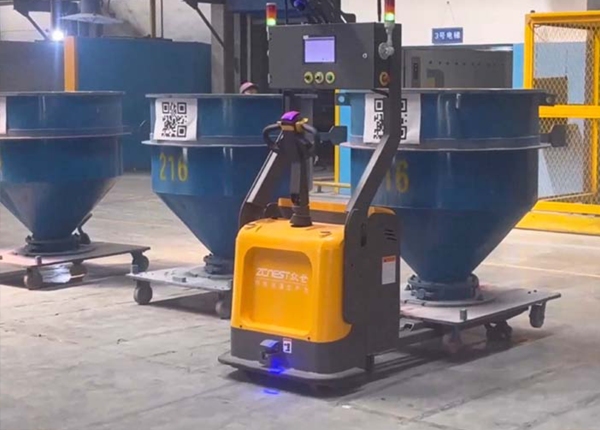
When several warehouse requests arrive at the same time, the fleet management system must decide which task to assign first. A shipment may be waiting at the outbound staging area, a production replenishment request may be approaching its deadline, and an inbound pallet may need to be moved away from a receiving dock.
Without agreed dispatch rules, operators may repeatedly change task priorities or request manual intervention. The result can be unnecessary travel, delayed orders, congested transfer points and inconsistent performance between shifts.
Warehouse operators should define task priorities before configuring the AGV forklift scheduling logic. The goal is not to make every task urgent. It is to establish consistent rules that reflect actual warehouse commitments.
Start by listing the transport tasks the warehouse expects the AGV system to perform. Avoid using one general category such as pallet movement for every request. Different jobs have different operational consequences when delayed.
Inbound putaway: move received pallets from designated receiving points to approved storage locations.
Outbound retrieval: retrieve inventory required for picking, consolidation or shipping.
Replenishment: move stock to forward-picking or other designated supply locations.
Internal relocation: transfer pallets between storage areas or reorganize inventory.
Exception recovery: handle approved recovery tasks after a blocked location, rejected transfer or incomplete operation.
For each task category, document the request source, destination, completion condition, deadline and consequence of delay. These attributes provide the information needed to design a meaningful priority system.
First-in, first-out scheduling is easy to understand, but it may not suit every warehouse. A newly created task could be more important than a request that has been waiting for several minutes.
For example, a pallet required for a confirmed shipment cutoff may deserve priority over a routine internal relocation. However, an urgent label should not automatically override traffic restrictions, safety conditions or an unavailable destination.
Define priority classes with explicit meanings. A practical starting point is:
| Priority Class | Typical Use | Dispatch Rule |
|---|---|---|
| Critical | Time-sensitive outbound or operational recovery | Assign promptly when the route and destination are available |
| High | Required replenishment or approaching deadline | Dispatch before standard work where feasible |
| Normal | Routine putaway and retrieval | Schedule according to queue order and fleet conditions |
| Low | Non-urgent relocation or housekeeping | Use available capacity without disrupting committed work |
These classes are a starting point, not universal settings. The actual number of classes, deadlines and escalation rules should match the warehouse's operating process.
A dispatch system must distinguish between a task that has not started and one that is already being executed. Reordering the queue is generally different from interrupting a moving vehicle or canceling a transfer in progress.
Specify whether a priority change can affect pending tasks, assigned tasks or tasks already underway. Also define how the system handles duplicate requests, canceled orders and destination changes.
For example, if an outbound order is canceled after a forklift has collected a pallet, the system should not simply erase the task. It needs a controlled instruction for the pallet's next permitted destination and a clear way to update the inventory transaction.
Make sure warehouse staff understand which changes they can initiate themselves and which require supervisor approval. This prevents uncontrolled manual overrides from becoming a routine operating method.
If every department can label its requests as critical, the priority system loses its value. A large number of urgent jobs can also push normal tasks into an ever-growing queue.
Set rules for authorized priority changes, maximum waiting times and escalation. Review whether a task remains urgent when its business condition changes. Where appropriate, use a deadline or age-based escalation rule rather than allowing a request to remain at low priority indefinitely.
Do not confuse task priority with vehicle movement permissions. A high-priority task must still respect traffic controls, pedestrian protection, route restrictions, load limits and transfer-station availability.
Before deployment, simulate or test scenarios that involve competing requests. A test with only one available task cannot show whether the priority logic works under pressure.
Several outbound requests arrive shortly before a shipping cutoff.
An urgent replenishment task appears while inbound putaway is already queued.
A high-priority task has no available destination.
A task is canceled after a vehicle has been assigned.
A vehicle becomes unavailable while carrying out a task.
Two departments submit conflicting requests for the same transfer point.
Measure waiting time by priority class, deadline compliance, manual overrides, task cancellations and the age of the oldest pending request. These metrics reveal whether the dispatch policy is effective without relying only on total task counts.
List all warehouse task categories and their business purpose.
Assign a clear definition to each priority class.
Document who can change priorities and when approval is required.
Define how cancellations and destination changes are handled.
Confirm that traffic and safety rules cannot be bypassed by urgency.
Agree on performance metrics and review them with warehouse supervisors.
Key checkpoint: Every priority rule should have a business reason, a system response and a measurable outcome. If operators cannot explain why one task moves ahead of another, the rule needs further clarification.
Task priorities should be designed alongside warehouse management processes, fleet control logic and physical transfer-point capacity. The same priority policy may perform differently in a narrow-aisle warehouse, a high-bay storage facility and a warehouse with concentrated outbound staging.
Before selecting an AGV forklift configuration, document the expected task mix, peak request volume, transfer locations, operating shifts and time-sensitive commitments. This information helps the engineering team assess whether the proposed fleet and scheduling strategy fit the actual workload.
📖 AGV Forklift Guide — Essential manual for selection and safety.
⚙️ How AGV Systems Work — A deep dive into navigation and logic.
⚖️ AGV vs. AMR Comparison — Choosing the right technology for your facility.
💰 AGV Cost and ROI — Evaluating investment and payback periods.












 Chinese
 English





