


AUTOMATED WAREHOUSE ENGINEERING
A warehouse transfer point is where vehicle positioning, pallet geometry, load stability and system signals must work together. Poorly designed pickup and drop-off stations can reduce the reliability of an otherwise capable AGV forklift fleet.
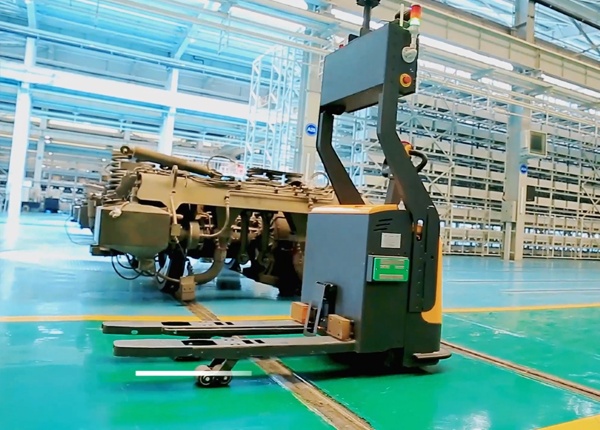
An AGV forklift may navigate accurately and lift the specified load, yet still fail to complete a transport task if the pallet is not positioned correctly at the pickup point or the receiving station cannot confirm that the load has been placed.
These problems often originate outside the vehicle itself. Transfer-station design determines where a pallet should stand, how the vehicle approaches it, what clearances are available and how the warehouse system confirms each step.
For warehouse managers planning automation, handover stations should be treated as part of the complete material-handling system rather than as simple floor locations.
Different warehouse processes require different handover arrangements. A receiving dock, a conveyor interface and a storage aisle entrance do not present the same physical or operational conditions.
Floor-level pallet pickup: The vehicle approaches a pallet positioned on the floor or at a defined pickup location.
Outbound staging: The AGV delivers pallets to a designated area where shipping staff or downstream equipment take over.
Conveyor interface: The vehicle transfers pallets between a forklift-handling area and a conveyor or other automated equipment.
Storage-zone handover: A pallet is transferred between vehicles, zones or operational processes at a defined location.
Equipment interface: The AGV works with a lift table, machine, dock or other equipment that has its own operating and safety conditions.
For each station, record its function, expected pallet types, transfer direction, access restrictions and the party responsible for confirming completion.
The station must provide a repeatable position for the pallet and a workable approach for the selected forklift model. The required geometry depends on the vehicle's fork arrangement, steering capability, load dimensions, approach direction and positioning method.
Document the expected pallet footprint, fork-entry direction, pallet underside clearance, load overhang and acceptable placement variation. Include damaged or non-standard pallets if they are expected to enter the automated process.
Do not determine the station dimensions from the nominal pallet size alone. The complete load may extend beyond the pallet, and the vehicle needs space to approach, align, insert its forks, lift and withdraw safely.
Where the vehicle approaches from a constrained aisle, evaluate the complete maneuver rather than only the final parking position. A station that appears to fit on a floor plan may be inaccessible when turning and load-clearance requirements are considered.
The floor around a transfer station should support the vehicle's positioning and lifting operations. Inspect local floor condition, slope, joints, surface damage and any changes in floor level that could affect approach consistency.
Also examine nearby racks, columns, doors, barriers, fire equipment and pedestrian routes. Include the full load envelope and the vehicle's movement envelope in the assessment.
Mark the proposed station location on the warehouse layout and verify it on site. Measurements should account for practical operating clearances, not just the dimensions of the vehicle body.
If the station is shared by people and automated equipment, define how access is controlled. The process should prevent a person from placing a pallet in an unsafe position or entering an active transfer area without the required safeguards.
A successful transfer requires both a physical action and a system record. The vehicle may report that it has completed a movement, but the warehouse process also needs to establish whether the pallet was actually picked up or delivered to the correct location.
Define the sequence for each station. A typical process may include:
The warehouse system creates a transport request with an approved pickup and destination.
The fleet controller assigns a suitable vehicle and confirms that the station is available.
The vehicle approaches the station and performs the required positioning checks.
The vehicle completes the pickup or drop-off operation.
Required station sensors, equipment signals or vehicle feedback confirm the physical state.
The task and inventory records are updated according to the agreed transaction rules.
The actual sequence will depend on the equipment and control architecture. Document what happens if a signal is missing, delayed or contradictory. A timeout should lead to a defined recovery process rather than an assumption that the transfer succeeded.
Transfer stations can become bottlenecks when several vehicles deliver pallets to the same location. The problem may be caused by limited physical capacity, slow downstream equipment, manual pallet removal or a station reservation rule that holds a location longer than necessary.
Measure the time required for a complete handover, including approach, positioning, lifting or lowering, confirmation and departure. Use these observations to estimate how many transfers a station can handle during a normal and peak operating period.
Where queues are expected, define staging positions and a maximum queue policy. The system should know whether a station is occupied, reserved, blocked or ready for another vehicle. Do not allow vehicles to queue in locations that obstruct emergency access or other warehouse operations.
Testing with an empty vehicle is not enough. A loaded forklift may have different clearance requirements and operating constraints, and the pallet itself may introduce positioning variation.
Test the smallest and largest approved pallet footprints.
Check the expected load overhang and fork-entry clearance.
Verify station signals and inventory updates after successful transfers.
Test missing confirmation signals and unavailable stations.
Check access control when people and vehicles operate in adjacent areas.
Repeat transfers under representative operating conditions and record failure causes.
Station purpose and transfer direction are documented.
Pallet dimensions, load envelope and fork-entry conditions are defined.
Approach, positioning and withdrawal clearances are verified on site.
Station readiness and completion signals have clear meanings.
Queueing, station reservation and recovery rules are agreed.
Acceptance tests include actual loads and abnormal conditions.
Key checkpoint: A transfer station is ready for automation only when the vehicle can access it, handle the intended load, complete the physical transfer and receive a reliable confirmation that matches the warehouse transaction.
When requesting a quotation, provide a warehouse layout that marks transfer stations, expected pallet types, approach directions and adjacent equipment. Photos and site measurements can help identify constraints that are not obvious in a two-dimensional drawing.
Ask the supplier to identify the station requirements that must be confirmed before commissioning, including any necessary sensors, communication signals, mechanical guides or changes to the floor layout. These requirements should be reflected in the project scope.
📖 AGV Forklift Guide — Essential manual for selection and safety.
⚙️ How AGV Systems Work — A deep dive into navigation and logic.
⚖️ AGV vs. AMR Comparison — Choosing the right technology for your facility.
💰 AGV Cost and ROI — Evaluating investment and payback periods.












 Chinese
 English





