


WAREHOUSE PERFORMANCE MANAGEMENT
Counting completed missions does not tell the whole story of an automated warehouse. The right AGV forklift KPIs show whether transport tasks are completed on time, where capacity is lost and which operating constraints need attention.
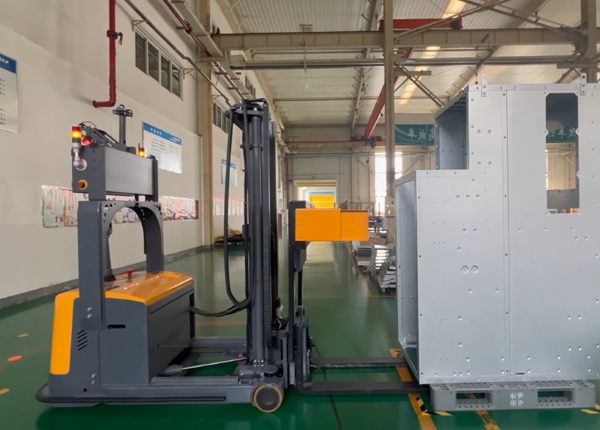
After an AGV forklift system enters operation, managers need reliable evidence that the fleet is supporting warehouse requirements. A daily task count may rise while outbound deadlines are still missed. Vehicle utilization may look high even though congestion is slowing deliveries. A low fault count may hide long periods when the system is waiting for pallets or destination confirmation.
Useful performance indicators must connect vehicle activity with the warehouse process. They should also use consistent definitions, so supervisors can compare shifts, operating areas and changes in workload without confusing one type of delay with another.
The first KPI group should establish whether the system completes the work it has been asked to perform.
Task completion rate: completed eligible tasks divided by eligible tasks created during the agreed measurement period. Define how canceled, duplicated and test tasks are treated so that the denominator remains consistent.
On-time completion rate: tasks completed by their defined deadlines divided by tasks with valid deadlines. This is particularly useful for outbound staging and time-sensitive replenishment.
Task aging: the time that pending tasks have remained open. Review the oldest pending tasks as well as average waiting time. An average can appear acceptable even when a small number of jobs are delayed for an unusually long period.
These measures should be separated by task type where possible. Comparing routine putaway with deadline-driven outbound retrieval in a single average can conceal important operational differences.
Vehicle travel time is only one part of a warehouse transport task. The full cycle may include waiting for assignment, traveling to the pickup point, aligning with the pallet, lifting the load, traveling to the destination, completing the handover and updating the warehouse transaction.
Record timestamps for the major stages that the system can reliably identify. This allows managers to distinguish slow travel from delays at pickup stations, destination queues or confirmation interfaces.
For example, if a task spends a large share of its elapsed time waiting at the receiving station, increasing the number of vehicles may not solve the actual problem. The station may need additional capacity or a faster downstream process.
Use a consistent definition of cycle time and compare similar task types. Report both the typical result and a high-percentile measure, such as the 90th percentile, to understand how long slower tasks take under normal conditions.
Vehicle availability indicates whether a unit is ready to perform its assigned work during the defined operating window. It should not be confused with utilization, which measures how much of that window is spent in a specified operating state.
Agree on which states count as available, active, charging, blocked, under maintenance or waiting for a task. The definitions should match the fleet controller's actual state records.
When downtime occurs, categorize it by cause where reliable information is available. Useful categories may include maintenance, battery charging, route obstruction, safety-related stop, communication loss, station unavailability and waiting for a manual process.
Do not automatically classify every stopped vehicle as a fault. A vehicle waiting for a pallet or a valid destination may be operating correctly while the surrounding process is unavailable.
Utilization can help identify idle capacity, but maximizing it is not always the right objective. A fleet running continuously near its practical limit may have insufficient capacity to handle request spikes, route interruptions or charging requirements.
Interpret utilization alongside task waiting time, deadline performance and queue length. If vehicle utilization rises while task completion time deteriorates, the system may be approaching a capacity constraint.
Likewise, low utilization does not automatically mean that too many vehicles were purchased. The fleet may be sized for peak demand, or the current period may have fewer inbound and outbound requests than usual.
Compare performance under similar workloads, shifts and operating conditions before making fleet-size decisions.
A task should not be counted as successful merely because a vehicle reaches its destination. The pallet must be handled correctly, the receiving location must be appropriate and the warehouse transaction must reach the required final state.
Track transfer failures, repeated pickup attempts, rejected handovers, inventory mismatches and manual recovery actions. Record the reason for intervention whenever possible.
Repeated failures at one location may indicate a station-design problem, an inconsistent pallet condition or a mismatch between the physical process and system configuration. These issues should be investigated by location and failure type rather than treated as unrelated vehicle faults.
A dashboard should make it easy to answer practical questions. Is the fleet completing urgent tasks on time? Which locations generate the longest queues? How much downtime comes from equipment faults rather than process delays? Are the same failures recurring after corrective action?
| KPI | What It Helps Identify | Useful Breakdown |
|---|---|---|
| Task completion rate | Whether assigned work is completed | Task category and shift |
| On-time completion | Deadline reliability | Priority and destination |
| Task waiting time | Queue and dispatch delays | Pickup point and task type |
| Vehicle downtime | Availability losses | Vehicle and reason code |
| Transfer failure rate | Physical or process reliability | Station and pallet type |
| Manual intervention rate | Recurring automation gaps | Cause and operating area |
Define each metric, its calculation and its measurement period.
Use consistent rules for canceled, duplicated and test tasks.
Capture timestamps for the main stages of a transport task.
Separate vehicle downtime from waiting caused by warehouse processes.
Break down failures by vehicle, location and reason.
Assign an owner and corrective action for each recurring issue.
Key checkpoint: Every KPI should support a decision. If a metric changes but the warehouse team cannot identify the likely cause or next action, improve the data breakdown before adding more dashboard indicators.
During an AGV forklift project, define the expected operational metrics before acceptance testing begins. Specify the test workload, task categories, operating window, measurement method and treatment of external interruptions.
Do not compare results collected under different workload conditions without noting the difference. A test with few tasks and no queues cannot establish performance during a busy operating period.
Ask the supplier which operational records can be exported, how vehicle states are defined and whether task-level timestamps can be reviewed. These details determine whether your team can monitor performance after project handover.
📖 AGV Forklift Guide — Essential manual for selection and safety.
⚙️ How AGV Systems Work — A deep dive into navigation and logic.
⚖️ AGV vs. AMR Comparison — Choosing the right technology for your facility.
💰 AGV Cost and ROI — Evaluating investment and payback periods.












 Chinese
 English





