


WAREHOUSE STORAGE CONTROL
Temporary storage is useful when receiving volume rises, outbound staging fills up or a warehouse needs short-term flexibility. For an AGV forklift operation, overflow locations must be controlled so that extra capacity does not create inventory errors or unsafe movements.
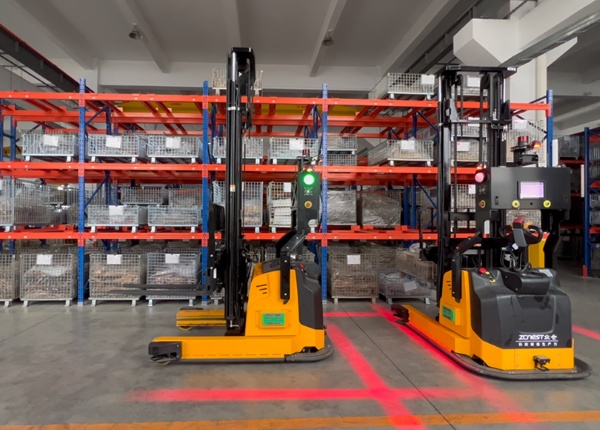
Warehouses rarely operate with perfectly stable inventory levels. A large inbound delivery may arrive before enough storage locations become available. Finished goods may accumulate before a shipment is released. A temporary hold area may be needed while inventory records or quality status are confirmed.
Manual operations can sometimes handle these situations through informal decisions. An automated forklift system needs explicit rules. If a pallet is placed in an unregistered floor position, the fleet may have no valid destination for future retrieval, and the warehouse management system may not know where the inventory is located.
Overflow storage should therefore be designed as a controlled extension of the warehouse layout, not as an unrestricted area where pallets can be left whenever space becomes tight.
Begin by listing the business situations that justify temporary storage. Each situation may require a different location type and release condition.
Inbound overflow when receiving volume temporarily exceeds normal putaway capacity.
Outbound staging overflow when shipments are ready before the assigned loading area becomes available.
Quality hold when goods cannot yet enter normal available inventory.
Short-term relocation when a storage zone is blocked or temporarily unavailable.
Peak-period buffering when demand patterns temporarily exceed normal staging capacity.
For every use case, identify who can authorize the location, which inventory statuses are permitted and what event releases the pallet from temporary storage. A quality-hold location, for example, should not be treated as ordinary available stock.
Every overflow position that the AGV system can use should have a defined identity and a physical boundary. Depending on the warehouse configuration, the position may be a floor location, a marked staging slot or a designated area managed as a set of individual pallet positions.
Do not register one large area as unlimited capacity if the actual floor can accommodate only a fixed number of pallets. The system should know how many positions are available and which ones are occupied or reserved.
Check the location layout against the vehicle's approach direction, pallet footprint, load envelope and required operating clearance. Avoid placing temporary positions where pallets can obstruct emergency routes, pedestrian access, rack access or vehicle turning paths.
Where multiple pallet types are handled, define which types are allowed in each overflow position. A location suitable for one pallet footprint or load height may not suit another.
Temporary storage introduces an additional movement into the inventory process. The warehouse system must record both the pallet's new location and any relevant inventory-status change.
Before moving a pallet, verify that its identifier is known and that the destination is valid for the inventory status. After the transfer, confirm that the transaction has reached the required state before making the pallet available for another task.
Define what happens if the physical movement succeeds but the system update fails. The recovery process should allow staff to reconcile the pallet's actual position and system record without creating a duplicate inventory balance or an incorrect retrieval task.
Where barcode or other identification checks are used, document when the identifier is read and which system owns the final inventory update. The physical and digital processes should use the same agreed transaction rules.
Temporary storage can become permanent if no one owns the release process. As a result, normal storage capacity may remain unavailable even after the original problem has disappeared.
Assign each overflow location or stored pallet a responsible team, a reason for use and a release condition. Depending on the process, the release condition could be a quality approval, an available rack location, a shipping instruction or the end of a temporary relocation.
Use a regular review to identify pallets that have exceeded the expected holding period. Escalate them to the appropriate warehouse owner rather than allowing the AGV system to keep moving new pallets into the same area.
If an overflow area is full, the system should reject or redirect new requests according to an approved rule. It should not silently assign a pallet to an unregistered floor position.
Adding temporary storage positions changes the warehouse's transport pattern. A new staging area may create longer travel distances, increase traffic around a doorway or concentrate vehicles near a small number of transfer points.
Evaluate the proposed overflow area with the expected inbound and outbound flows. Confirm that loaded vehicles can access the positions and leave them without blocking other operations.
Where the overflow area is intended for peak demand, test it under the conditions in which it will actually be used. Consider whether the normal dispatch priorities still work when additional putaway tasks enter the queue and whether outbound staging has sufficient capacity.
Temporary storage should relieve a capacity constraint rather than transfer that constraint to another part of the warehouse.
The operating procedure should state who can open or close overflow locations, how locations are marked, which pallet types are permitted and how occupancy is confirmed. Include a clear process for situations where the physical floor differs from the system record.
A useful control process includes these steps:
Authorize the overflow area and confirm that its physical layout is safe for the intended vehicle.
Register the permitted locations and their capacity in the relevant warehouse and fleet systems.
Define eligible inventory statuses, pallet types and task categories.
Assign ownership and a release condition for each temporary use.
Monitor occupancy and holding time during operation.
Close the area only after the remaining inventory and system records have been reconciled.
Every approved temporary position has a unique location identity.
Physical capacity and permitted pallet types are defined.
Inventory status and location updates are synchronized.
Access, traffic flow and emergency routes remain clear.
Each temporary pallet has an owner and release condition.
Full-area and failed-transaction procedures are documented.
Occupancy and holding time can be reviewed by supervisors.
Key checkpoint: An overflow location is operationally useful only when the warehouse knows what can be stored there, how much capacity remains, where each pallet is recorded and who is responsible for releasing it.
When planning an AGV forklift deployment, provide the supplier with both the normal storage layout and the temporary areas expected to be used during operation. Identify whether these areas are permanent, seasonal or activated only when certain conditions occur.
Ask how new locations are registered, how occupancy is managed, how location changes are communicated to the fleet controller and how the system behaves when all approved positions are occupied.
These questions are particularly important in warehouses where inbound and outbound volumes fluctuate. A system designed only around the standard layout may require additional configuration before it can handle temporary operating conditions reliably.
📖 AGV Forklift Guide — Essential manual for selection and safety.
⚙️ How AGV Systems Work — A deep dive into navigation and logic.
⚖️ AGV vs. AMR Comparison — Choosing the right technology for your facility.
💰 AGV Cost and ROI — Evaluating investment and payback periods.












 Chinese
 English





