


WAREHOUSE IDENTIFICATION SYSTEMS
Choosing an identification method for an automated warehouse affects pallet verification, inventory accuracy and transport-task reliability. Barcode and RFID technologies solve different problems, so the right choice depends on how loads are identified and how warehouse transactions are controlled.
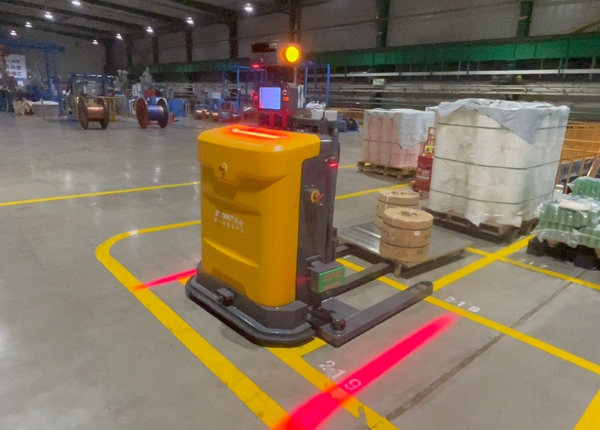
An AGV forklift warehouse may need to identify a pallet at receiving, verify a load before storage, confirm a retrieval or associate a physical movement with an inventory transaction. The identification method must support the actual process at each point.
Barcode systems generally require a readable label and an appropriate scanning position. RFID uses radio-frequency communication between a reader and a compatible tag, potentially allowing identification without direct visual alignment. However, RFID performance depends on tag placement, reader configuration, surrounding materials and the operating environment.
Neither method automatically guarantees correct inventory. The warehouse still needs rules connecting the identified pallet, the assigned task and the physical destination.
Before selecting hardware, determine whether the warehouse needs to identify individual pallets, product cases, storage locations or equipment. These are different identification requirements and may require different technologies.
Pallet identification: associates a unique pallet or load identifier with an inventory record.
Location identification: verifies the intended rack position, floor slot or transfer station.
Product identification: confirms SKU, batch or other product-level information where required.
Task verification: checks whether the identified load matches the transport request.
A pallet barcode may identify the handling unit without containing all product details. The warehouse management system can use that identifier to retrieve the associated SKU, quantity, batch and inventory status.
Document which information must be captured at each checkpoint and which system owns the authoritative record. Avoid placing unnecessary data directly on labels when a stable identifier linked to the inventory database is sufficient.
| Factor | Barcode | RFID |
|---|---|---|
| Identification method | Optical reading of a printed code | Radio-frequency reading of a compatible tag |
| Visibility | Code must be visible to the scanner | Direct visual alignment may not be necessary |
| Common failure factors | Damage, dirt, glare, poor orientation | Tag placement, interference, material effects, stray reads |
| Infrastructure | Labels and suitable scanners | Compatible tags, readers and antenna configuration |
| Typical consideration | Scan access and label maintenance | Read-zone control and tag compatibility |
These are general differences, not a guarantee that one technology will outperform the other in every warehouse. The final choice should be validated using the actual pallets, loads, labels and equipment.
Barcode reliability depends heavily on where the label is placed. If an AGV forklift approaches a pallet from a fixed direction, the label should be positioned where the scanner can read it during the intended movement without creating an unsafe maneuver.
Check the label position when pallets are loaded, wrapped, stacked or placed inside racks. Film, straps, torn corners and overhanging cartons can obscure a code that was readable before loading.
Also verify that the scanner can read the label across the expected range of pallet positions and lighting conditions. If the system requires a manual scan from an awkward angle, the identification process may introduce delays even when the barcode itself is technically correct.
Establish a label-quality standard covering print contrast, size, placement and replacement of damaged labels. Include responsibility for maintaining the labels in the warehouse operating procedure.
RFID may be useful where optical line-of-sight is difficult or identification needs to occur as a load passes through a defined area. Its effectiveness depends on the tag type, reader and antenna arrangement, frequency, mounting position and materials near the tag.
Metal structures, liquid-containing products and dense loads can affect RFID performance depending on the system design. Multiple tags within a read zone can also create ambiguity if the process does not distinguish the intended pallet from nearby inventory.
For this reason, test the read zone with real warehouse conditions. Verify whether the reader detects only the intended load, whether nearby tags generate unwanted reads and whether the result remains consistent when pallets are positioned differently.
Specify the required read event clearly. A tag detected near a station does not necessarily mean that the pallet has been physically transferred or that the inventory transaction should be completed.
The identification system should support a defined sequence between the warehouse management system, fleet controller and AGV forklift. Before a movement begins, the system may need to verify the task, pallet identifier, destination and inventory status.
After the physical operation, the required confirmation should establish whether the load was picked up or deposited successfully. The system should not update inventory solely because a vehicle passed a scanner or an RFID tag entered a read zone.
Document the response to common errors, including an unknown pallet ID, a mismatched load, a duplicate scan, an unreadable label and a tag detected at the wrong station. Each condition needs an explicit action rather than an assumption that the task can continue.
Run a controlled test using representative pallets, loads and warehouse locations. Include normal operating conditions as well as foreseeable problems.
Verify identification of each approved pallet type and label or tag position.
Test damaged, dirty, obscured or incorrectly positioned identifiers.
Check for duplicate reads or unintended reads from nearby pallets.
Confirm that mismatched pallet IDs are rejected correctly.
Verify that successful physical transfers create the expected inventory updates.
Record failure rates and the manual actions needed to recover.
Compare technologies using the same operational scenarios. Include hardware, consumables, installation, maintenance, integration and exception-handling costs when evaluating the long-term impact.
Required identifiers and transaction checkpoints are documented.
Barcode visibility or RFID read-zone requirements are verified.
All intended pallet types have been tested.
Unknown, duplicated and mismatched identifiers have defined responses.
Physical transfer confirmation is separated from tag or code detection.
Maintenance and exception-handling responsibilities are assigned.
Key checkpoint: Select the identification method that reliably supports your actual warehouse transactions. The best option is not necessarily the one with the most advanced hardware, but the one that produces dependable identification under real operating conditions.
When requesting an AGV forklift proposal, provide sample pallet labels, load photos, the planned identification checkpoints and any existing barcode or RFID standards. Explain whether the warehouse already uses a WMS and which system is responsible for inventory records.
Ask the supplier to identify required scanners, readers, communication interfaces and exception-handling logic. Confirm how the proposed system will be tested and how identification failures will be recorded for later analysis.
📖 AGV Forklift Guide — Essential manual for selection and safety.
⚙️ How AGV Systems Work — A deep dive into navigation and logic.
⚖️ AGV vs. AMR Comparison — Choosing the right technology for your facility.
💰 AGV Cost and ROI — Evaluating investment and payback periods.












 Chinese
 English





