


WAREHOUSE CONNECTIVITY ENGINEERING
Reliable wireless communication helps an AGV forklift fleet exchange task updates, report status and coordinate with warehouse systems. Network planning should account for the actual building, moving vehicles, storage racks and operational consequences of temporary connectivity loss.
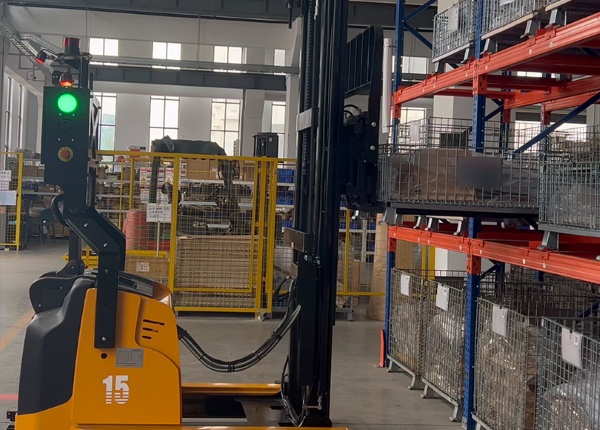
Wireless coverage that works well in an office may not perform consistently throughout a warehouse. Tall racks, metal structures, changing inventory positions and moving vehicles can affect radio propagation. A network may appear reliable during a stationary test but behave differently when forklifts travel through narrow aisles or operate near loading areas.
For an AGV forklift project, the goal is not simply to provide a strong signal everywhere. The network must support the system's actual communication requirements, and the vehicle and fleet controller must have a defined response when connectivity becomes unavailable.
Network planning should therefore combine a site survey, application requirements, roaming tests and controlled failure testing before the system enters routine operation.
Start by identifying which components communicate over the warehouse network and what each connection is used for. Depending on the architecture, this may include fleet control, vehicle status reporting, task updates, monitoring tools and interfaces with other warehouse systems.
For each communication path, document the required availability, expected data flow, response expectations and the operational effect of an interruption. Not every message has the same timing or business importance.
For example, a delayed reporting dashboard may have a different consequence from a communication failure that prevents a vehicle from receiving an authorized task update. The system design should reflect these differences without assuming that every function must use the same network behavior.
Ask the supplier which network functions are required during normal movement, task execution, charging and recovery. Confirm which functions can continue locally and which depend on a live connection to fleet control.
Map the routes and locations that the AGV forklifts are expected to use. Include storage aisles, rack ends, receiving areas, outbound staging, charging points, lifts and any other areas where vehicles may stop or transfer loads.
A survey should assess coverage under realistic conditions, not only from the warehouse entrance. Tall metal racks and stored goods can change the radio environment, while vehicle movement may expose weak areas that are not apparent during a stationary measurement.
Record areas where signal strength, interference or connection stability may require further investigation. Verify the proposed access-point placement against the physical layout and the intended routes.
Do not rely solely on a generic coverage map or the nominal range stated for network equipment. Actual performance depends on building conditions, antenna placement, configuration and the devices installed on the vehicles.
When a vehicle moves between wireless access points, the network must maintain an appropriate connection as the vehicle changes coverage areas. The transition is commonly described as roaming, but its behavior depends on the wireless configuration, client hardware and network settings.
Test the routes the vehicles will actually use, including movement through rack aisles, around corners and between the warehouse and adjacent operating areas. Observe whether connections remain stable and whether any interruption affects task reporting or vehicle behavior.
Pay particular attention to locations where vehicles frequently stop, turn or handle loads. A short interruption may have different consequences depending on whether the vehicle is traveling, aligning with a pallet or waiting for a system response.
Document any required network settings with the IT team and AGV supplier. Avoid changing roaming or security parameters in a live warehouse without checking their effect on all connected devices and applications.
Warehouses may contain wireless barcode scanners, handheld terminals, cameras, mobile devices and other equipment sharing parts of the radio environment. Network planning should account for these devices and any known sources of interference.
Evaluate the expected number of connected vehicles and the traffic generated by normal operation, diagnostics and monitoring. The network should be assessed under representative peak conditions rather than only when a few devices are connected.
Confirm that network segmentation, authentication and security controls are compatible with the AGV system. Coordinate changes with the organization's IT and cybersecurity teams so that the automation network meets applicable policies.
Where multiple buildings or separate warehouse zones are involved, verify how connectivity is provided between them. Do not assume that the same coverage and roaming behavior will apply across outdoor transitions, fire doors or other physical boundaries.
A network outage should trigger a predictable and documented response. The correct behavior depends on the vehicle design, task state, safety architecture and manufacturer's instructions.
Determine what the vehicle does if it loses contact while idle, traveling without a load, carrying a pallet or performing a transfer. Confirm which actions remain controlled locally and which require communication with fleet control.
Also define how the system detects reconnection, restores task state and prevents duplicate commands after communication returns. The fleet controller should not assume that a task failed simply because its final status message was delayed.
Recovery procedures should specify who can authorize resumption, how unresolved tasks are reconciled and what information operators need to report. Staff should not attempt to bypass protective functions or force a vehicle to resume operation without following the approved procedure.
Network acceptance should include both coverage measurements and application-level tests. A signal measurement alone cannot prove that task updates, roaming and recovery behave correctly.
Test every planned route and operational zone.
Observe roaming while vehicles move between coverage areas.
Repeat tests with representative warehouse activity and connected devices.
Verify task reporting and status synchronization during normal operation.
Simulate an approved communication interruption in a controlled test environment.
Confirm recovery behavior and reconcile task states after reconnection.
Record the test locations, conditions, observed interruptions and corrective actions. Retest affected routes after access-point relocation or material network configuration changes.
All vehicle routes and communication-dependent functions are documented.
Coverage has been checked across the actual operating area.
Roaming has been tested while vehicles move along representative routes.
Interference and connected-device demand have been assessed.
Network security requirements have been reviewed with IT.
Communication-loss behavior is documented for different task states.
Acceptance records include recovery and reconnection tests.
Key checkpoint: A warehouse network is ready for AGV operation when the required routes and applications have been tested under realistic conditions and the system's behavior during communication loss is clearly defined.
Before commissioning, clarify the division of responsibility between the AGV supplier, network provider and warehouse IT team. Agree who supplies wireless hardware, configures access points, manages credentials, reviews security settings and investigates communication incidents.
Provide the supplier with the warehouse layout and planned vehicle routes. Request the system's communication requirements and any network assumptions that must be validated before installation.
Including these requirements in the project plan reduces the risk of discovering coverage gaps only after the vehicles are operating in the warehouse.
📖 AGV Forklift Guide — Essential manual for selection and safety.
⚙️ How AGV Systems Work — A deep dive into navigation and logic.
⚖️ AGV vs. AMR Comparison — Choosing the right technology for your facility.
💰 AGV Cost and ROI — Evaluating investment and payback periods.












 Chinese
 English





