


FLEET DISPATCH AND WAREHOUSE CONTROL
When receiving, replenishment, putaway and shipping compete for the same AGV forklift fleet, dispatch rules determine which work moves first. A practical priority strategy must balance deadlines, inventory needs, travel distance and warehouse congestion without leaving routine tasks waiting indefinitely.
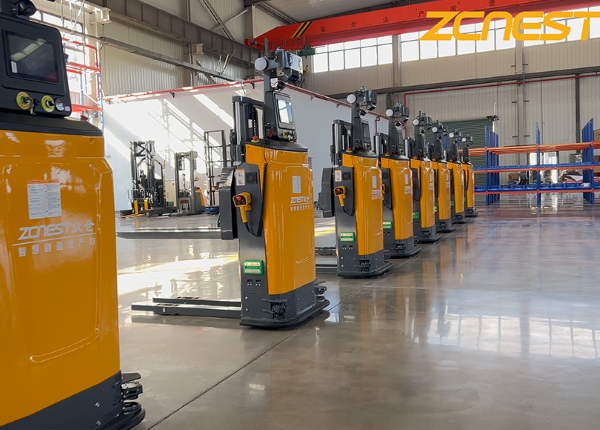
A warehouse can have sufficient AGV forklift capacity and still experience delays if tasks are released in the wrong order. For example, an outbound pallet may need immediate transport to meet a loading deadline, while a replenishment task may be necessary to prevent a picking location from running empty.
Giving every task the same priority does not resolve these conflicts. Nor does assigning the highest priority to every urgent request. If too many tasks are marked urgent, the fleet controller loses the distinction between genuinely time-critical work and routine transport.
Effective dispatch begins with clearly defined business priorities, measurable rules and a way to review the results against actual warehouse performance.
Start by identifying the main categories of transport work in the warehouse. Each category should have a clear purpose and a defined consequence if the task is delayed.
Outbound shipping: moves confirmed orders or pallets toward dispatch and loading areas.
Replenishment: supplies picking or production-support inventory locations before stock becomes unavailable.
Inbound putaway: transfers received and approved pallets into designated storage positions.
Internal relocation: moves inventory between storage zones to support space management or operational requirements.
Time-sensitive transfers: handles work with a documented deadline or a specific downstream dependency.
These categories are starting points, not universal priority rankings. A replenishment task that supports an imminent shipment may be more urgent than a routine outbound movement scheduled for later.
Define the business impact of delay for each task type before translating that impact into dispatch logic.
Priority determines which eligible task should be considered first. Eligibility determines whether the task is ready to execute at all.
A high-priority task should not be dispatched when the pallet is missing, the destination is unavailable or the required transfer station is not ready. The system should identify the blocking condition and retain the task for an appropriate follow-up action.
Before ranking tasks, define readiness checks such as:
The task has valid pickup and destination information.
The pallet or handling unit is available at the expected location.
The destination can accept the intended load.
The required equipment and vehicle type are available.
Any required upstream confirmation has been received.
This separation prevents the dispatcher from repeatedly assigning tasks that cannot proceed. It also makes blocked work visible to supervisors instead of allowing it to compete silently with executable tasks.
A useful priority model combines a small number of business factors rather than relying on a single manually assigned number.
| Factor | Question to Resolve |
|---|---|
| Deadline | When must the task reach the next process? |
| Business impact | What stops or slows down if this task is delayed? |
| Dependency | Are other tasks or processes waiting for this movement? |
| Readiness | Can the pickup and destination proceed now? |
| Travel and congestion | Will the task create unnecessary travel or block a busy area? |
| Waiting time | Has a routine task been waiting too long? |
For example, a warehouse may establish several priority levels for critical deadline-driven work, operationally important work and routine transport. The definitions should be documented so that different shifts classify similar situations consistently.
Use waiting-time escalation where appropriate. This helps prevent routine tasks from being postponed indefinitely by a continuous stream of urgent requests.
Priority inflation occurs when operators or upstream systems mark too many tasks as urgent. Once most tasks have the same high priority, the classification no longer helps the fleet make meaningful decisions.
Define who may assign or change priority levels and under what conditions. For example, the warehouse system may assign a standard priority based on the task type, while a supervisor can authorize a temporary escalation when a documented business need arises.
Record the reason for manual overrides and review how often they occur. Frequent overrides may indicate that the standard rules do not reflect the actual warehouse workflow.
Where possible, use a deadline or downstream dependency to justify urgency instead of relying only on subjective labels. A task should not be marked urgent simply because the requesting department wants it completed first.
Business priority should not be the only dispatch consideration. Two tasks with similar urgency may differ significantly in travel distance, aisle access and destination readiness.
Where the fleet controller supports it, travel efficiency can help determine which eligible task should be executed first. However, reducing distance should not override a critical deadline or create an unsafe traffic conflict.
Review repeated movements through narrow aisles, shared intersections and busy staging areas. A dispatch rule that sends many vehicles toward the same constrained area may increase waiting time even if each task appears efficient in isolation.
Consider the combined effect of task priority, route availability and destination capacity. The best dispatch decision is the one that supports the warehouse process as a whole, not merely the next individual movement.
Once the rules are implemented, compare actual performance against the intended operating priorities. Useful measures include task waiting time, on-time completion, blocked-task duration, queue size and the number of manual priority overrides.
Break results down by task type, shift or warehouse zone where the data allows. A fleet-wide average may conceal a recurring delay in replenishment or a queue that builds up at outbound staging.
Review whether high-priority tasks are completed within the expected window and whether routine work continues to progress. If one task category consistently dominates the queue, examine whether the priority rules, release timing or upstream process need adjustment.
Make changes in a controlled manner. Record the original rule, the reason for the change and the operational result so that the team can distinguish a genuine improvement from a temporary fluctuation.
Task categories and their business impact are documented.
Readiness checks are separate from priority ranking.
Deadline, dependency and waiting-time rules are defined.
Manual priority changes have clear authorization rules.
Congestion and destination readiness are considered.
Routine tasks cannot remain indefinitely at the bottom of the queue.
Performance is reviewed by task category and operating zone.
Key checkpoint: A good dispatch policy makes the business reason for each priority level clear, filters out tasks that are not ready and gives supervisors enough visibility to identify persistent queue problems.
When specifying an AGV forklift project, provide examples of your warehouse's real task conflicts, such as urgent outbound pallets competing with replenishment work. Explain which deadlines are fixed, which tasks depend on other processes and who may change priority.
Ask the supplier to demonstrate how these rules are configured, monitored and adjusted. Confirm which decisions are handled by the WMS and which belong to fleet control, then test representative scenarios before the system goes live.
📖 AGV Forklift Guide — Essential manual for selection and safety.
⚙️ How AGV Systems Work — A deep dive into navigation and logic.
⚖️ AGV vs. AMR Comparison — Choosing the right technology for your facility.
💰 AGV Cost and ROI — Evaluating investment and payback periods.












 Chinese
 English





