


WAREHOUSE TRANSFER INTERFACES
A transfer station is where an AGV forklift exchanges a load with a conveyor, staging area, production interface or warehouse process. Poorly defined handover conditions can cause delays, misaligned pallets and incomplete tasks even when the vehicle and fleet control system operate correctly.
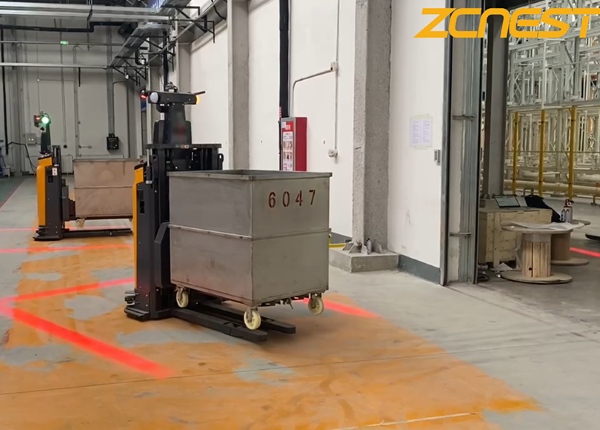
A reliable transfer station must do more than provide a place for a forklift to stop. It must present the load consistently, provide enough clearance for the vehicle to approach and withdraw, and communicate whether the receiving process is ready.
In a manual warehouse, an operator may compensate for an awkward pallet position or an incomplete handover through experience. An automated system needs those conditions addressed through equipment design, defined tolerances and explicit control logic.
Transfer-station requirements should therefore be reviewed before the warehouse layout and automation interfaces are finalized.
Start by documenting what each station does and which process supplies or receives the load. A station serving inbound receiving may have different requirements from one used for outbound staging or pallet transfer to a conveyor.
For each station, identify:
The source and destination of the pallet.
The supported pallet types and load dimensions.
The intended approach and withdrawal direction.
The required handover sequence and confirmation signals.
The response when the station or load is not ready.
If several pallet types share the same station, document their dimensional differences and verify that the equipment can accommodate them within the permitted handling tolerances.
A clear station definition helps the warehouse, equipment supplier and automation team work from the same assumptions.
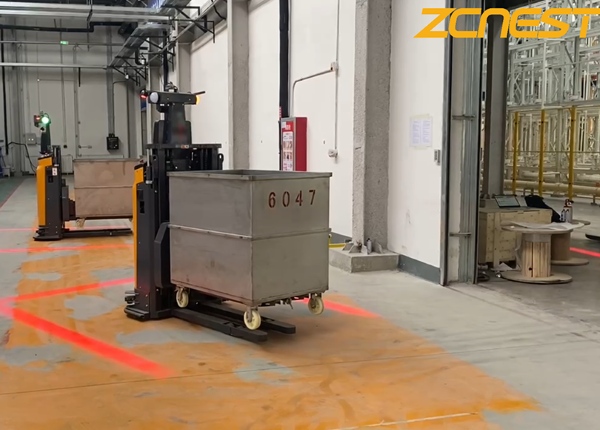
The station must allow the selected AGV forklift to approach, align, pick up or deposit the load, and withdraw without interfering with nearby structures or traffic.
Review the complete movement path rather than measuring only the stopping point. Include turning space, fork insertion distance, load overhang, vehicle dimensions and the clearance required while carrying a pallet.
Also check the relationship between the station and adjacent racks, walls, columns, doors, conveyors and pedestrian routes. A station may fit on a drawing but still be difficult to use if the approach angle or available alignment space is insufficient.
Use the actual vehicle and load specifications to verify the design. Do not assume that a station suitable for a standard manual forklift will automatically suit an autonomous vehicle with different dimensions or handling behavior.
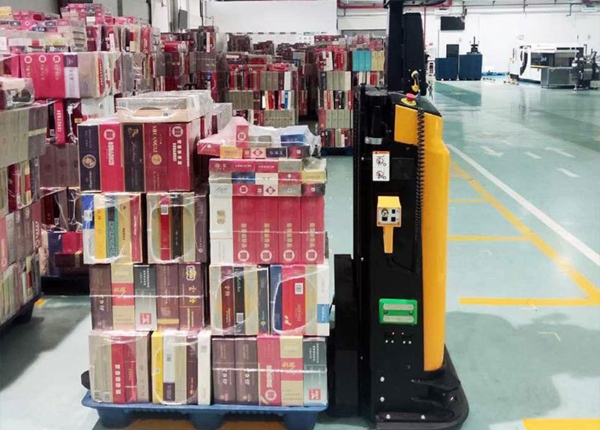
The physical position of a pallet at the station has a direct effect on pickup reliability. Define where the pallet should sit, which direction it should face and what variation is acceptable.
Consider the station's support surface, pallet stops, guides or other positioning features. These may help create a repeatable load position, but their design must be compatible with the pallet structure and the AGV forklift's handling method.
Check whether the pallet can arrive skewed, overhanging or offset from the intended pickup position. If upstream equipment places loads, establish how it verifies that the pallet has reached the correct position before the AGV approaches.
Where load variation is unavoidable, confirm the permissible range with the supplier and test representative conditions. Do not rely on the vehicle to correct every positioning error unless that capability has been explicitly validated.
A transfer station needs a clear way to indicate whether it can accept or release a load. Depending on the design, this may involve sensors, a PLC interface, a conveyor controller or another approved signal mechanism.
Document the conditions that establish readiness. For example, the station may need to confirm that the receiving position is empty, the conveyor has stopped at the required point or the downstream process has authorized the transfer.
Define the handover sequence explicitly:
The warehouse or control system issues a valid transfer task.
The station confirms that the required position is ready.
The AGV approaches and performs the approved load-handling action.
The system verifies the relevant physical completion conditions.
The station and fleet controller exchange the required completion status.
The next process is released according to the agreed sequence.
The actual sequence depends on the equipment. The important point is that a command to transfer a load should not be treated as proof that the transfer has physically completed.
Stations that receive loads from several sources may need to coordinate arrival order, temporary buffering and destination availability. Without clear rules, one pallet can occupy the position needed by another task.
Define how the system handles a station that is occupied, unavailable or holding a load whose identity has not been confirmed. Determine whether the AGV should wait, move to an approved buffer or return the task for rescheduling.
If the station has more than one physical position, specify how each position is identified and how the controller determines which one is available. The location logic should match the actual equipment arrangement.
Also review how long a load can remain at the station and who is responsible for removing it if the downstream process stops. A handover point should not become an uncontrolled storage area.
Common transfer failures include a pallet that is not present, a load positioned outside the permitted range, a station that never confirms readiness and a downstream conveyor that does not release the load.
For each condition, define what the AGV does, what the station reports and what the operator should see. Include a way to distinguish between a transfer that was never started and one whose physical outcome is uncertain.
Test sensor faults, delayed signals, occupied positions and communication interruptions using an approved test procedure. Verify that the system does not release the next operation before the required conditions have been met.
Ensure that operators can identify the affected station and task without needing to inspect unrelated equipment. Clear fault messages and traceable task records can reduce the time required to diagnose a problem.
Station purpose and supported load types are documented.
Approach, turning, fork insertion and withdrawal clearances are verified.
Load presentation and positioning tolerances are defined.
Station-ready and transfer-complete signals are specified.
Occupied and unavailable station conditions have defined responses.
Downstream equipment interfaces are tested.
Fault messages and recovery responsibilities are documented.
Key checkpoint: The station should provide repeatable load positioning, sufficient vehicle clearance and reliable handover confirmation. A successful transfer must be based on verified conditions, not simply on the completion of a movement command.
Before commissioning the full fleet, test each station with the intended AGV forklift, representative pallet types and the equipment that supplies or receives the load.
Record the pickup and drop-off results, positioning issues, readiness-signal behavior and exception outcomes. Include repeated cycles to determine whether the station performs consistently under the planned operating conditions.
When requesting a proposal, provide station drawings, load specifications, equipment interface details and the expected handover sequence. Ask the supplier to identify any additional sensors, positioning features or control interfaces required for reliable operation.
📖 AGV Forklift Guide — Essential manual for selection and safety.
⚙️ How AGV Systems Work — A deep dive into navigation and logic.
⚖️ AGV vs. AMR Comparison — Choosing the right technology for your facility.
💰 AGV Cost and ROI — Evaluating investment and payback periods.





 Chinese
 English